
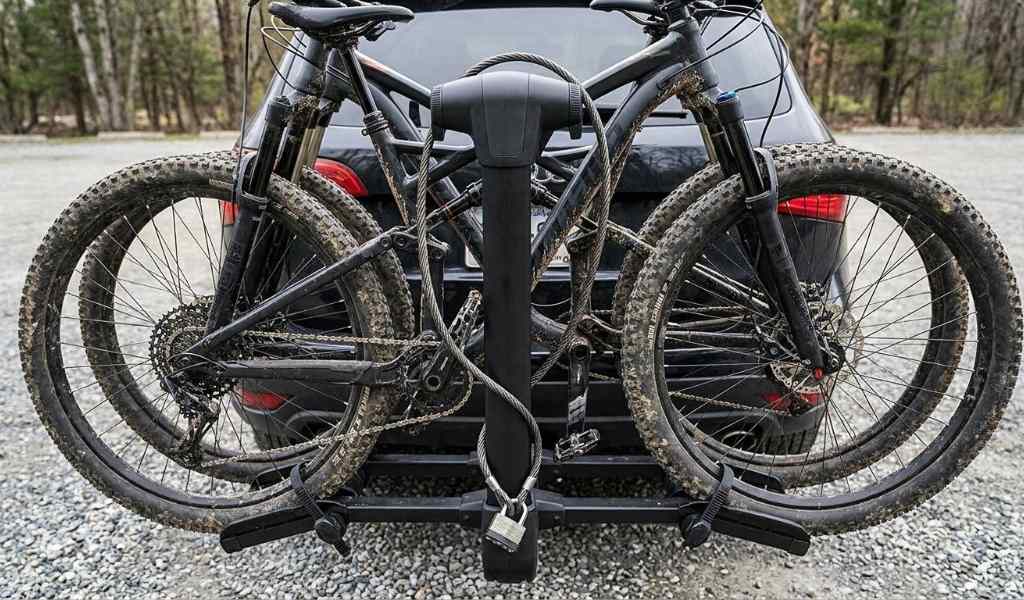
Securing a Thule bike rack takes two separate layers, a lock that keeps the rack attached to the vehicle, such as a locking hitch pin or roof clamp knob, and a cable lock through each bike’s frame to stop someone from simply unstrapping and walking off with a bike. No combination of locks makes a loaded rack fully theft-proof, but layering them adds enough time and difficulty to deter most casual theft, especially at an unattended rest stop or trailhead.
Where and how you park matters too, since a visible, well-lit spot discourages opportunistic theft on its own. This guide covers integrated rack locks, cable locks for the bikes themselves, locking the rack to the vehicle, what to actually lock through on the bike, and general theft prevention habits worth building.
Why Lock a Thule Bike Rack?
A parked car with bikes on the back is an easy target, especially at a trailhead, rest stop, or hotel parking lot where it sits unattended for a while. Good security usually means layering a few different locks rather than relying on just one: one that keeps the rack itself attached to the car, and one or more that keep each bike attached to the rack.
No lock makes a loaded rack fully theft-proof, but each layer adds time and difficulty for anyone trying to take a bike, which is often enough to deter casual theft. This guide covers the main lock types Thule racks use and how to combine them, building on the loading and securing basics in our complete Thule bike rack guide.
Integrated Rack Locks
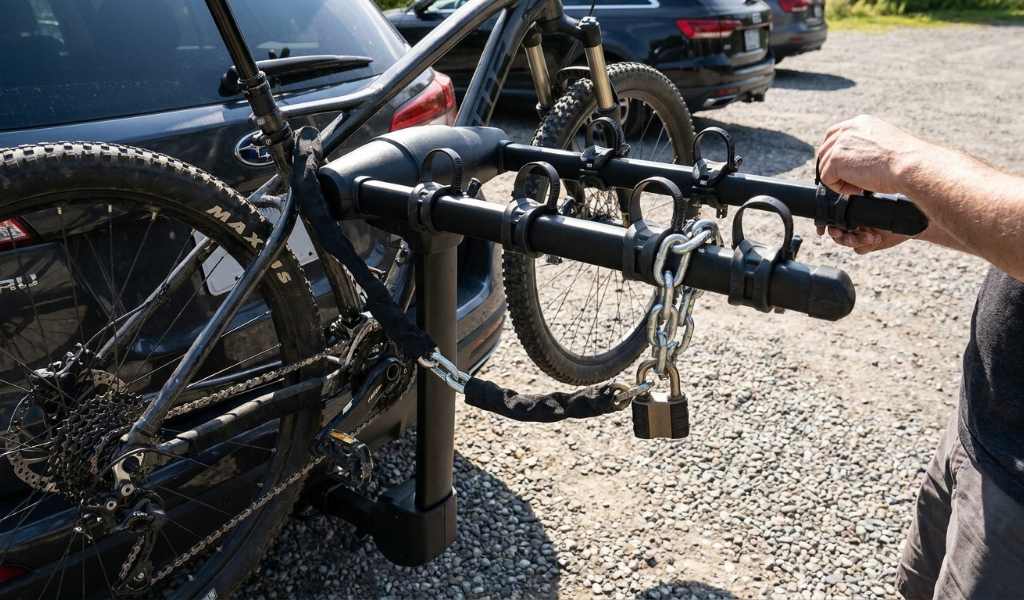
Many Thule racks include a built-in locking core, often on the hitch pin, the mounting knob, or the main frame latch, that uses a key to prevent someone from removing the rack from the vehicle without unlocking it first. These are usually a small cylinder lock built into the part of the rack that would otherwise come apart with a quick hand-turn.
If your rack came with one, make sure to actually lock it every time, not just when parking somewhere that feels risky, since a habit of locking it only sometimes tends to turn into never locking it. Keep a spare key somewhere accessible (not only on the one keychain), since a lost key on an integrated lock usually means a locksmith or a replacement part.
Cable Locks for the Bikes Themselves
An integrated rack lock keeps the rack on the car, but it doesn’t stop someone from simply undoing a bike’s strap and walking off with it. A cable lock threaded through each bike’s frame and the rack closes that gap.
To use one well:
- Thread the cable through the main frame triangle, not just a wheel, so the lock secures the part of the bike that’s hardest to remove quickly.
- Loop the cable around a fixed part of the rack itself, not just another bike, so a thief can’t take the whole group at once.
- Choose a cable thick enough to resist bolt cutters, since thin cables are cut in seconds.
- Lock each bike individually when possible, rather than looping one long cable through all of them, so cutting one lock doesn’t free every bike.
Many Thule racks sell a matching cable lock accessory sized to loop through multiple bikes at once, which is worth adding if your rack didn’t include one.
Locking the Rack to the Vehicle
Securing the bikes is only half the job, since the whole rack, bikes included, can be lifted off an unlocked hitch or roof mount. How you lock the rack itself depends on the mount type:
- Hitch racks: a locking hitch pin replaces the standard clip pin, requiring a key to remove the rack from the receiver.
- Roof racks: most clamp-style mounts include a lock on the clamp knob itself, preventing the whole unit from being unclamped from the crossbar.
- Trunk racks: generally rely on the strap tension and hooks rather than a key lock, so pairing one with a cable lock through the vehicle (looping a strap or cable through a fixed point like a tow loop) adds a layer these racks otherwise lack.
A locked rack base combined with locked bikes means a thief needs to defeat two separate locks, not one, to get away with anything.
Frame and Wheel Security Tips
What you lock through matters as much as the lock itself. A few habits improve the outcome:
- Always lock through the main frame, never just a wheel, since quick-release wheels come off in seconds without tools.
- If a wheel is removed for loading (as with some fork-mount roof racks), lock that wheel separately to the rack or frame as well.
- Position the lock where it’s hard to reach or see clearly, rather than hanging loose and obvious.
- Avoid leaving extra slack in a cable lock; a tight loop is harder to maneuver tools into.
A frame lock paired with a rack base lock covers the two most common theft scenarios: someone taking a single bike, and someone taking the whole rack.
General Theft Prevention
Locks help, but a few habits around where and how you park cut the risk further:
- Park under a light or in view of a window or camera when leaving a loaded rack overnight.
- Avoid leaving bikes on the rack overnight when a garage or indoor option is available instead.
- Remove unusually expensive bikes from the rack for a hotel stay rather than relying on locks alone.
- Take a photo of each bike’s frame and serial number before a trip, which helps with police reports or insurance claims if something does go missing.
None of this replaces the physical locks, but combined with them, it meaningfully lowers the odds of a theft turning into a real loss.
Frequently Asked Questions
Do all Thule racks come with a lock?
Not all. Some include an integrated lock on the hitch pin or mount, while others need an aftermarket cable lock added separately.
What’s the best way to lock multiple bikes at once?
Lock each bike individually through its frame to a fixed point on the rack, rather than looping one cable through every bike, so one cut lock doesn’t free them all.
Can someone still steal the whole rack if the bikes are locked?
Yes, unless the rack itself is also locked to the hitch or crossbar with a locking pin or locking clamp knob, which is why both layers matter.
Is a cable lock enough, or do I need a U-lock?
A cable lock is convenient for a bike rack since it threads through tight spaces, but a thick, cut-resistant cable is important; thin cables are cut quickly.
Should I remove my bikes at a hotel overnight?
It’s a reasonable precaution, especially for expensive bikes, since a parked car overnight gives much more time for a theft attempt than a short stop.