

A standard Thule bike rack often isn’t rated for an e-bike’s weight, so carrying one safely means checking the rack’s per-bike limit against your e-bike’s actual weight, usually 40 to 70 lb, before you load it. E-bikes also tend to have different frame shapes, step-through, cargo, or full-suspension, and wider tires than a typical bike, which can affect which mount style and wheel tray actually fit.
Platform-style hitch racks rated specifically for e-bikes, often with a loading ramp included, are generally the easiest and safest option. This guide walks through matching per-bike weight limits to your e-bike, when removing the battery before loading helps, frame and tire compatibility, using a loading ramp safely, and how total rack capacity changes once e-bikes are in the mix.
What Makes E-Bikes Different on a Bike Rack?
E-bikes carry a motor, battery, and usually a sturdier frame, which pushes their weight well past a standard bike. Where a typical road or mountain bike weighs 20 to 30 lb, most e-bikes fall between 40 and 70 lb, and heavier cargo e-bikes can go higher still.
That extra weight changes three things: which racks are even rated to hold the bike, how the rack’s hitch or mount handles the added leverage, and how careful you need to be loading and unloading. Not every Thule rack in our complete bike rack guide is built for this, so checking the per-bike rating before buying matters more with e-bikes than with standard bikes.
Individual Bike Weight Limits
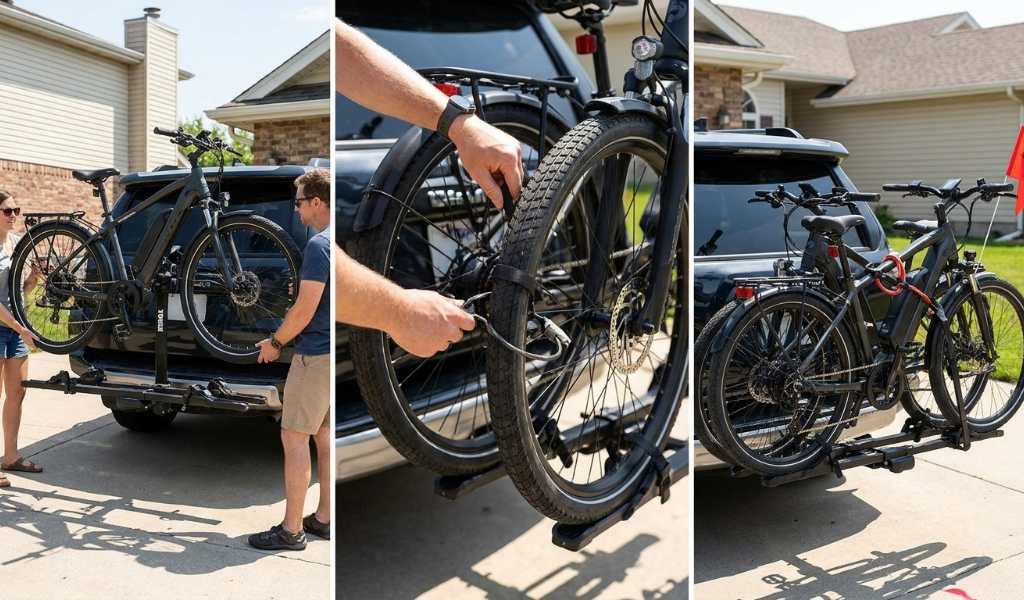
Standard Thule hitch racks list a per-bike weight limit, commonly 37.5 to 40 lb, which many e-bikes exceed on their own. Thule’s e-bike rated racks raise that per-bike limit to 60 lb or more to cover heavier models.
Before buying, weigh your e-bike (check the manufacturer’s spec sheet if you can’t get it on a scale) and compare it against the rack’s stated per-bike limit, not just its total capacity. A rack rated for 4 standard bikes at 37.5 lb each is not automatically safe for 2 e-bikes at 55 lb each, since the per-bike limit is the number that matters for each individual slot.
Should You Remove the Battery Before Loading?
It depends on the rack’s rated weight limit and how the battery is mounted. If your e-bike’s battery is removable and the combined bike-plus-battery weight is close to or over the rack’s per-bike limit, taking the battery out before loading brings the bike under the limit and makes it noticeably easier to lift.
A few points to weigh:
- A removable battery taken out before loading should be stored safely inside the vehicle, not left exposed to weather or vibration on the rack.
- An integrated, non-removable battery means the full bike weight goes on the rack regardless, so the rack itself needs to be rated for that weight.
- Removing the battery doesn’t reduce strain on the frame or wheels from the motor and heavier components, only the weight on the rack’s capacity rating.
When the numbers are close, removing the battery is a simple way to add a safety margin without buying a different rack.
Frame Compatibility for E-Bikes
E-bikes come in a wider range of frame shapes than standard bikes, which affects which rack mount style works best:
- Step-through e-bikes: lack a top tube for a frame clamp to grip, so a wheel-mount or platform-style hitch rack usually works better than a frame-clamp design.
- Cargo e-bikes: longer wheelbases may not fit standard rack spacing; check the rack’s maximum wheelbase or bike length before buying.
- Mid-drive motor placement: some frame-clamp racks grip near the bottom bracket, where a mid-drive motor sits, so confirm the clamp point doesn’t land on the motor housing.
- Full-suspension e-bikes: the rear shock can interfere with some frame clamps, making a wheel-mount design the safer choice.
Platform-style hitch racks, which cradle the wheels rather than clamp the frame, tend to be the most forgiving option across different e-bike shapes.
Tire Width and Wheel Mount Fit
Many e-bikes, especially cargo and fat-tire models, run wider tires than a standard bike, sometimes 3 inches or more. Standard wheel trays on some racks are sized for narrower road or mountain bike tires and may not hold a fat tire securely.
Check the rack’s listed maximum tire width before buying, and look for models that specifically advertise fat-tire compatibility if your e-bike has wide tires. A rack with an adjustable or oversized wheel tray accommodates a broader range of tire widths without needing a separate fat-tire adapter kit.
Using a Loading Ramp
Lifting a 50 to 70 lb e-bike onto a hitch rack by hand is a lot harder than lifting a standard bike, which is why several Thule hitch racks for e-bikes include a slide-on loading ramp as a standard or optional accessory.
To use one safely:
- Set the ramp against the rack’s loading tray before wheeling the bike up, rather than trying to lift it partway.
- Walk the bike up slowly, keeping a hand on the handlebars and the other on the saddle or frame for control.
- Have the rack tilted down (if your model supports it) during loading for a gentler ramp angle.
- Avoid loading ramps on wet or icy ground, since the reduced grip increases the risk of the bike sliding sideways.
If your rack didn’t come with a ramp and you’re regularly loading a heavy e-bike alone, an aftermarket ramp accessory is worth the investment.
Total Rack Capacity With E-Bikes
A rack’s total capacity drops when the bikes are heavier, even if the number of wheel slots stays the same. A hitch rack rated to hold 4 standard bikes at 37.5 lb each (150 lb total) might only safely hold 2 e-bikes at 60 lb each (120 lb) once you factor in the rack’s own overall weight rating, not just the per-bike limit.
For exact combinations, like fitting four bikes where one or more are electric, check the rack’s total weight rating against the combined weight of everything you plan to load, not just the bike count. Our guide to carrying four bikes on a Thule rack covers how capacity changes with mixed loads of standard and electric bikes.
Frequently Asked Questions
Can any Thule hitch rack carry an e-bike?
Not all of them. Check the per-bike weight limit against your e-bike’s actual weight, since standard racks are often rated well below typical e-bike weight.
Do I need to remove the battery before loading my e-bike?
Only if you’re close to or over the rack’s weight limit, or want to reduce lifting effort. It’s not required if the rack is rated for the bike’s full weight.
Will a roof rack work for an e-bike?
Technically yes if the crossbars and mount are rated heavy enough, but lifting a 50-plus lb bike overhead is difficult, so a hitch rack with a loading ramp is usually a better fit.
How many e-bikes can I fit on one rack?
Fewer than standard bikes, typically 2 on a rack rated for 4 standard bikes, since the total weight rating fills up faster.
Do fat tire e-bikes need a special rack?
Often yes, since standard wheel trays may not fit tires 3 inches or wider. Look for racks that list fat-tire compatibility.