
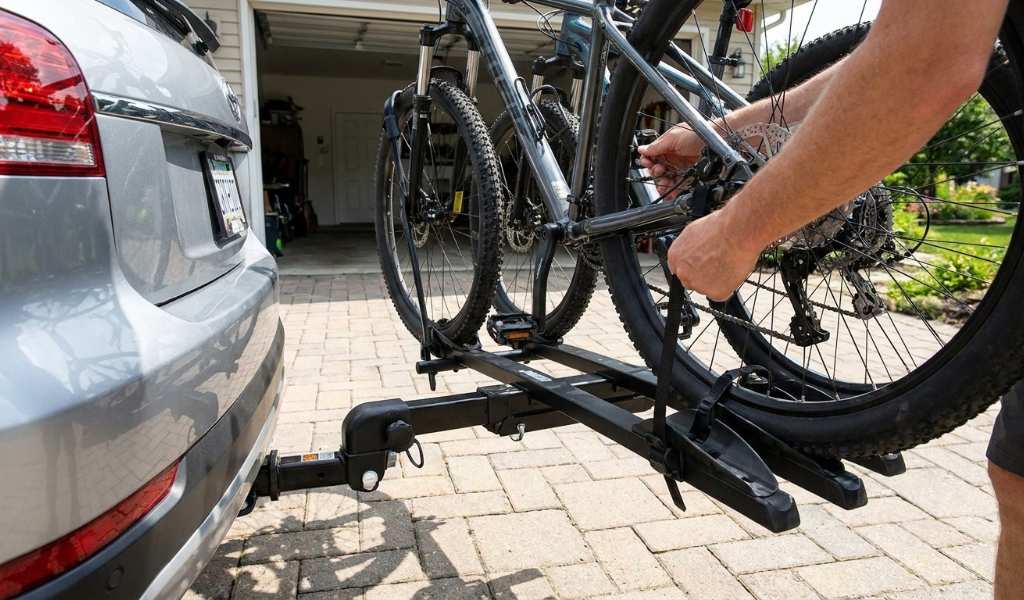
A Thule bike rack is a car-mounted carrier that holds one or more bikes for transport, built in four main styles, hitch, roof, trunk, and truck bed mounted, each suited to a different vehicle and budget. Hitch racks carry the most bikes and load the easiest; roof racks work on vehicles without a hitch; trunk racks are the cheapest and need no extra hardware; truck bed racks suit pickup owners.
Picking the right one comes down to what your vehicle already has, how many bikes you need to carry, and how much lifting you’re willing to do. This guide walks through every rack type, how to match one to your car, how many bikes each style holds, installation and loading steps, compatibility with different bikes, and the maintenance that keeps a rack working for years.
What Is a Thule Bike Rack?
Thule is a Swedish brand that makes bike racks for cars, SUVs, trucks, and vans, along with roof boxes, cargo carriers, and other outdoor transport gear. A Thule bike rack is built to carry one or more bicycles on a vehicle without damaging the bikes, the car, or the rack itself along the way.
The racks fall into a few main families based on where they attach to the vehicle: the trailer hitch, the roof, the trunk or tailgate, or the truck bed. Each family trades off differently on cost, how many bikes it holds, how easy it is to load, and how much it affects fuel economy and garage clearance.
Most Thule racks share a few traits: a frame made from aluminum or steel, adjustable arms or trays to fit different bike sizes, and some form of integrated security, whether that is a locking core, a cable lock, or both. Higher-end models add tool-free installation, tilt or fold-down features for trunk access, and anti-sway cradles that keep bikes from knocking into each other on rough roads.
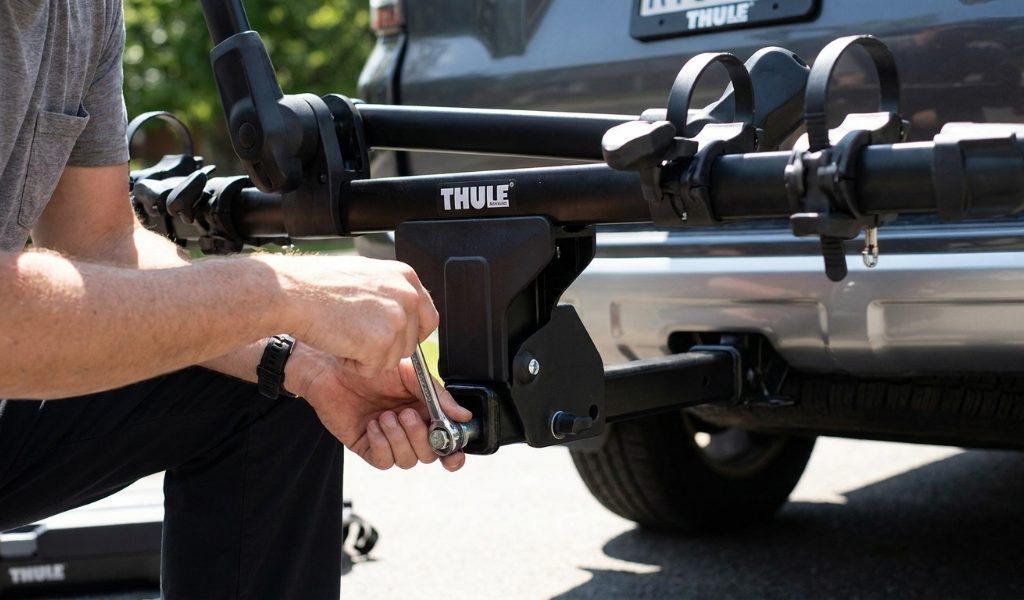
Thule has built racks and outdoor transport gear since 1942, and the brand’s bike racks carry a reputation for durability and resale value that holds up well against cheaper off-brand alternatives. That reputation shows up in small details: thicker-gauge steel and aluminum, rubberized contact points that don’t mar paint, and a multi-year warranty on most models. The brand sells through bike shops, outdoor retailers, and its own site, and most parts, from replacement straps to locking cores, stay available for years after a rack is discontinued, which matters if you plan to keep a rack for the long haul.
Types of Thule Bike Racks
Thule builds four main rack categories, and the right one depends on your vehicle, your garage, and how many bikes you’re hauling.
Hitch Mounted Bike Racks
These slide into a trailer hitch receiver on the back of the vehicle and are the most popular option for most drivers. They’re quick to load since bikes sit low to the ground, they don’t touch the car’s paint, and many models tilt down for trunk access or fold flat when not in use. The trade-off is that you need a hitch receiver installed first, and the rack adds length to the back of the car. See our guide to Thule hitch bike racks for installation steps and loading tips.
Roof Mounted Bike Racks
Roof racks mount on crossbars and carry bikes either by the frame, the wheel, or an upside-down fork mount. They keep the back of the car clear, work on vehicles without a hitch, and let you carry bikes alongside a roof box or kayak. The downsides are the lift needed to load a bike overhead, reduced fuel economy from wind drag, and the real risk of forgetting the extra roof height and clipping a garage or drive-through. Full details are in our Thule roof bike rack guide.
Trunk Mounted Bike Racks
These strap onto the trunk, hatchback, or rear door using straps and hooks, with no hitch or roof bars required. They’re the most affordable and the easiest to store, but they rely on correct strap placement and can risk scuffing paint if padding isn’t used, and they generally hold fewer bikes with lower weight limits than hitch racks. Our Thule trunk bike rack guide covers fitting it to your specific car.
Truck Bed and Other Bike Rack Options
For pickup trucks, Thule also makes bed-mounted systems that clamp onto the bed rail or truck bed itself, keeping bikes secure without blocking the tailgate. These suit drivers who already use the bed for other gear and want the bikes kept separate and upright rather than laid flat.
These mounts typically use clamps or a quick-release pin system to attach directly to the bed rail or bed floor, and many fold flat when not in use so the bed stays usable for other cargo. They’re less common than hitch, roof, or trunk racks, but are worth considering if you already haul other gear in the bed regularly and don’t want bikes competing for space with tools or equipment.
Comparing Rack Types at a Glance
| Rack type | Best for | Main advantage | Main drawback |
| Hitch mounted | Most vehicles with a hitch, 2+ bikes | Easy loading, highest capacity | Needs a hitch receiver |
| Roof mounted | Vehicles without a hitch, mixed cargo | Keeps rear of car clear | Overhead lifting, height risk |
| Trunk mounted | Occasional use, no extra hardware | Cheapest, most portable | Lower capacity, strap dependent |
| Truck bed mounted | Pickup truck owners | Keeps bikes upright, bed stays usable | Truck-specific fit |
If you’re still weighing the trade-offs, the hitch rack is the safest default for most drivers who already have, or can add, a hitch receiver.
How to Find the Right Thule Bike Rack for Your Vehicle
Start with what your car already has. A vehicle with a factory or aftermarket hitch receiver is the easiest fit for a hitch rack, since you just need to match the receiver size (1.25-inch or 2-inch) to the rack. No hitch, and don’t want to install one? A roof rack works on almost any car with crossbars, or a trunk rack works on most hatchbacks and sedans with no extra hardware at all.
Sedans and coupes usually suit trunk or roof racks well, since their trunk lids and roof lines give good strap or crossbar contact. SUVs and minivans with a factory hitch are well suited to hitch racks, especially for carrying three or more bikes. Pickup trucks have the bed-mounted option on top of the usual hitch and roof choices.
Also check your vehicle’s spoiler, rear wiper, or liftgate hinge design before buying a trunk rack, since these can interfere with strap placement. Thule’s online fit guide lets you enter your exact vehicle to confirm hitch class, roof rack compatibility, and which specific rack models are approved for your make and model.
Before you buy, run through this quick checklist:
- Confirm whether your vehicle has a factory hitch, and if so, its class and receiver size.
- Check your roof’s load rating if you’re considering a roof rack, especially if you’ll carry other gear alongside bikes.
- Count how many bikes you need to carry now, and whether that number might grow.
- Weigh the heaviest bike you’ll carry, especially if an e-bike is in the mix.
- Decide how often you’ll install and remove the rack, since some styles are easier to leave on than others.
Answering these five questions narrows the field considerably before you start comparing specific models.
How Many Bikes Can a Thule Rack Carry?
Capacity depends on the rack type and model, not just the vehicle. Here’s the typical range for each category:
| Rack type | Typical capacity | Typical per-bike weight limit |
| Hitch mounted | 2 to 5 bikes | 37.5 to 60 lb |
| Roof mounted | 1 to 2 bikes per rack (add more racks for more bikes) | 20 to 45 lb |
| Trunk mounted | 2 to 3 bikes | 29 to 35 lb |
| Truck bed mounted | 1 to 2 bikes per unit | 40 to 50 lb |
For more than 2 bikes on a roof, you simply add another crossbar-mounted carrier, since each one typically holds one bike. Hitch racks scale the other way, with dedicated 4 and 5 bike platform models for families or group rides. Always check the total rack weight limit as well as the per-bike limit, since loading several heavy e-bikes can hit the rack’s overall capacity before you run out of slots.
If you’re specifically carrying four bikes, see our guide on choosing a Thule bike rack for 4 bikes. If any of those bikes are electric, check our guide to carrying e-bikes on a Thule rack first, since e-bike weight changes which racks are even an option.
Key Features to Look For When Buying a Thule Bike Rack
Beyond the basic rack type, a handful of features separate a good purchase from one you’ll regret:
- Tool-free installation: most current Thule racks use knobs and levers instead of a wrench, which matters if you’ll be installing and removing the rack often.
- Tilt or swing-away access: on hitch racks, this lets you reach the trunk or tailgate without unloading bikes first, a feature worth prioritizing if you load and unload gear frequently.
- Integrated locks: a locking core on the rack itself, plus support for an add-on cable lock, covers both the rack and the bikes.
- Anti-sway cradles: these keep bikes from knocking into each other over bumps and potholes, especially valuable with 3 or more bikes loaded.
- Weight capacity with margin: buying a rack rated slightly above your heaviest bike and total load gives room to grow into a heavier bike later, like an e-bike.
- Compatibility with your specific frame types: especially relevant if you own a mix of standard, step-through, and fat-tire bikes.
A rack that checks most of these boxes will usually cost more upfront, but it tends to be easier to live with day to day and holds its resale value better.
How Much Does a Thule Bike Rack Cost?
Pricing varies widely by rack type and capacity. Trunk racks are the most affordable, typically running $100 to $200 for a 2 to 3 bike model. Hitch racks sit in the middle to upper range, with 2-bike platform models starting around $300 and 4 or 5 bike platform racks, along with e-bike rated models, reaching $600 to $900. Roof racks fall in a similar range to hitch racks once you add the cost of crossbars if you don’t already have them, often pushing total spend past $500 once bars, feet, and the bike mount are all accounted for.
A few cost factors worth weighing:
- Adding a hitch receiver where none exists typically costs $150 to $400 installed, on top of the rack itself.
- Locking hitch pins and cable locks are usually $20 to $50 add-ons if not included.
- E-bike rated racks and loading ramps carry a premium over standard models, often $100 to $200 more.
Spending more upfront on a rack rated for your actual needs, rather than the cheapest option that technically fits, usually costs less over time than replacing an undersized rack later.
How to Install a Thule Bike Rack
Installation steps vary by rack type, but the general process looks like this:
- Confirm fit first. Match the rack to your hitch class, roof bar type, or trunk shape before unboxing, using Thule’s fit guide or the rack’s listed compatibility.
- Attach the base. For hitch racks, slide the shank into the receiver and tighten the hitch pin or anti-rattle bolt. For roof racks, clamp the carrier onto the crossbars at the recommended spacing. For trunk racks, open the trunk or hatch partway and hook the upper straps over the edge.
- Secure the straps or clamps. Tighten all straps, clamps, or knobs by hand, following the order in the included manual, and check that nothing rocks or shifts when pushed.
- Test before loading. Give the rack a firm shake and try to lift or twist it. A properly installed rack should not move independently of the vehicle.
- Recheck after driving. Pull over after the first few miles on any new install and retighten anything that settled.
Most Thule racks use tool-free knobs and levers, so a Phillips screwdriver or small wrench is usually the only tool you’ll need, if any. Our Thule hitch bike rack installation guide and Thule roof bike rack installation guide walk through the model-specific steps in more detail.
If the rack still rattles after following every step, check for a worn anti-rattle bolt tip, a receiver with excess play from age or corrosion, or a mismatched shank size using an unapproved reducer sleeve. Any of these can leave a rack feeling loose even when every bolt is properly tightened, and most are a quick fix once you know what to look for rather than a sign the rack itself is faulty.
How to Load and Secure Bikes on a Thule Rack
Load heaviest bikes closest to the vehicle on a hitch rack, since this keeps the center of gravity low and reduces sway. On a roof rack, load from the back of the car forward if using multiple carriers, so you’re not reaching over an already-loaded bike. On a trunk rack, load the largest bike into the center cradle first for the most stable base.
Once bikes are in place:
- Tighten the frame or wheel straps snugly, but not so tight that they deform the tire or cut into the frame.
- Alternate handlebar and seat direction on adjacent bikes so they don’t knock pedals or bars together.
- Use the rack’s anti-sway cage or cradle if included, which keeps bikes from swinging side to side.
- Give the whole load a shake test before driving, checking that no bike rocks independently of the rack.
- Recheck strap tension after the first 10 to 15 minutes of driving, since straps can settle.
Many hitch racks also offer a swing-away feature, pivoting the entire loaded rack to the side rather than just tilting it down, which gives full access to the trunk or tailgate without removing any bikes. This is especially useful for SUVs and minivans where the trunk or tailgate opens wide and a simple tilt wouldn’t clear it.
For theft prevention and locking the bikes themselves to the rack, see the full breakdown in our Thule bike rack lock guide.
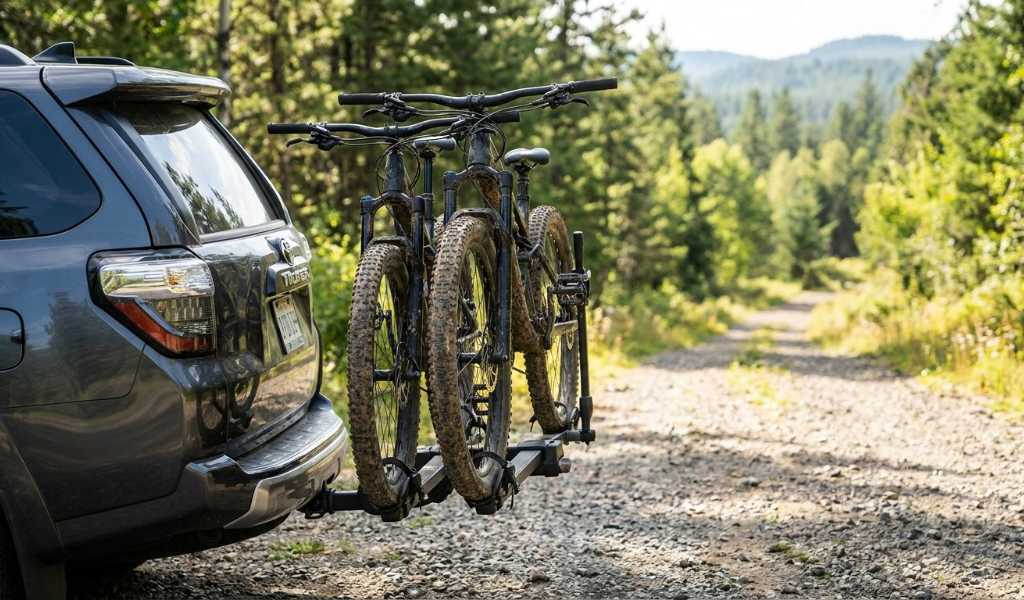
Thule Bike Rack Compatibility With Different Bikes
Most bikes with a standard diamond frame fit Thule racks without extra parts. A few bike types need special attention:
- E-bikes: heavier overall, often 40 to 70 lb, so they need a rack rated for that per-bike weight and sometimes a reinforced hitch tongue. See our full Thule bike rack for e-bikes guide.
- Fat tire bikes: wider tires (4 inches or more) may not fit standard wheel trays, so check the tray width or use a frame-mount rack instead.
- Kids’ bikes: small frames can slip through adult-sized arms, so look for an adapter bar or a rack specifically rated for smaller wheel sizes.
- Full-suspension and step-through frames: frame-mount racks that clamp the top tube can struggle here, so a wheel-mount or hanging-style rack is usually the safer fit.
- Carbon frames: avoid frame-clamp racks that grip the top tube directly, since clamping pressure can damage carbon; a wheel-mount design is the safer choice.
When in doubt, Thule lists maximum tire width, wheel size range, and frame compatibility for each rack model on its product pages, so checking those specs against your bike avoids a mismatch at the store or after delivery.
How to Maintain a Thule Bike Rack
A little regular care keeps a Thule rack working smoothly for years and prevents the slow corrosion that causes most long-term failures.
- Rinse off road salt, mud, and grime after winter driving or dusty trips, especially around moving joints.
- Check straps, hooks, and bolts every few months for fraying, cracking, or loosening, and replace worn straps before they fail.
- Apply a light coat of silicone spray or bike lube to pivot points and folding mechanisms once or twice a year.
- Store the rack indoors or under cover when not in use to slow UV and rust damage.
- Wipe down locking cores and keyholes occasionally, since grit buildup is a common cause of sticky locks.
Our Thule bike rack maintenance and cleaning guide covers a full seasonal checklist along with fixes for common wear issues.
Common Thule Bike Rack Problems and Solutions
| Problem | Likely cause | Fix |
| Rack wobbles on the hitch | Worn hitch pin or loose anti-rattle bolt | Tighten the anti-rattle bolt; replace a worn hitch pin |
| Bikes sway or knock together | Straps too loose, or no anti-sway cage used | Retighten straps; add or adjust the anti-sway cradle |
| Lock sticks or won’t turn | Dirt or corrosion inside the core | Clean with compressed air and a dry lubricant, not oil |
| Rack won’t fold or tilt | Grime buildup on the pivot mechanism | Clean the joint and apply silicone spray |
| Straps fraying or cracking | UV exposure and age | Replace straps; store the rack out of direct sun |
| Rack scratches the car | Missing or worn protective padding | Add felt pads or replacement bumpers at contact points |
For theft-related issues specifically, like a locking core that won’t release, try Thule bike rack lock.
Frequently Asked Questions
Do I need a hitch for a Thule bike rack?
No. Hitch racks need a receiver, but Thule also makes roof-mounted and trunk-mounted racks that work without one.
Can a Thule rack carry an e-bike?
Yes, with the right model. E-bikes are heavier, so check the per-bike weight rating before loading one, and see our e-bike rack guide for specifics.
How many bikes can I fit on one rack?
Most single racks carry 1 to 5 bikes depending on type, with hitch racks offering the highest capacity. See the capacity table above for details by rack type.
Will a Thule rack fit my car?
Use Thule’s online fit guide with your exact make, model, and year to confirm hitch class, roof rack compatibility, or trunk rack fit before buying.
Are Thule bike racks lockable?
Many models include an integrated lock for the rack itself, and most support an add-on cable lock to secure the bikes. See our lock and security guide for the full picture.
How often should I maintain my Thule rack?
A quick rinse after dirty or salty drives, plus a full strap and bolt check every few months, is enough for most riders. Full details are in our maintenance guide.