
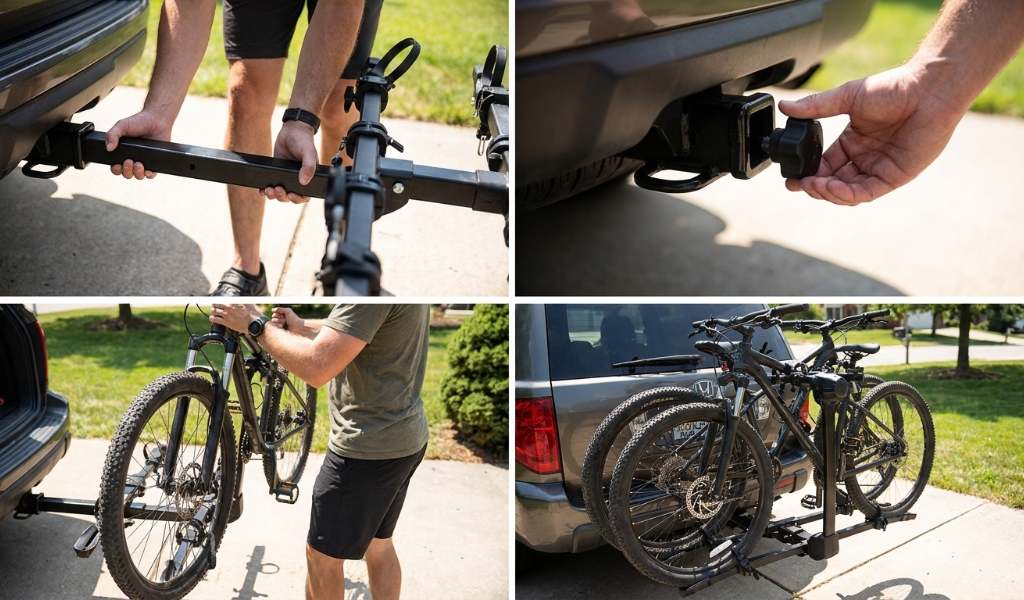
A Thule hitch bike rack mounts into your vehicle’s trailer hitch receiver and carries two to five bikes low to the ground, without touching the car’s paint or requiring an overhead lift. It’s the most popular Thule rack style because it tilts down or folds flat for trunk access, handles heavier bikes like e-bikes more comfortably than roof or trunk racks, and installs in minutes with mostly tool-free hardware.
The only requirement is a hitch receiver, either factory-installed or added aftermarket, sized to match the rack’s 1.25-inch or 2-inch shank. This guide covers checking your receiver size, installing the rack step by step, loading and strapping bikes correctly, using the tilt and fold features, and running the safety checks worth doing before every drive.
What Is a Thule Hitch Bike Rack?
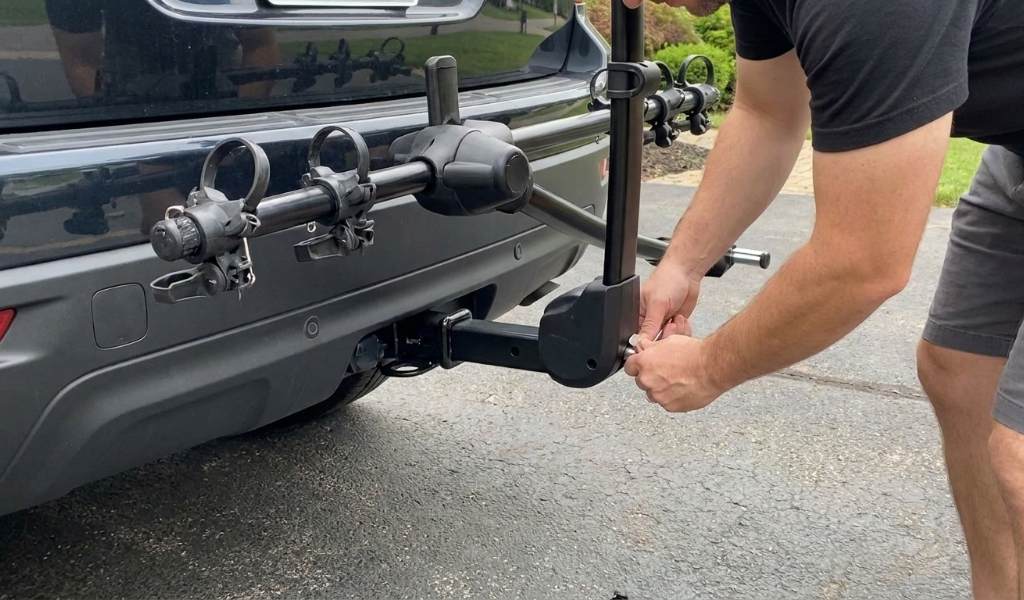
A hitch-mounted Thule rack attaches to the trailer hitch receiver on the back of a vehicle and carries bikes by their wheels or frame on arms, trays, or a platform. It’s the category most drivers reach for first because bikes load low to the ground, nothing touches the car’s paint, and most models fold up or tilt down when not needed.
Compared to roof or trunk racks, hitch racks generally hold more bikes, handle heavier bikes like e-bikes more comfortably, and are easier to load for most people. The one requirement is a hitch receiver, which either comes factory-installed or can be added aftermarket for most vehicles. For a wider look at how hitch racks compare to roof and trunk options, see our complete Thule bike rack guide.
Hitch Receiver Compatibility
Thule hitch racks are built for two standard receiver sizes:
| Receiver class | Opening size | Typical use |
| Class I/II | 1.25 inch | Sedans, smaller SUVs, lighter loads (usually 2 bikes) |
| Class III/IV | 2 inch | SUVs, trucks, minivans, heavier loads (3 to 5 bikes) |
Check your owner’s manual or look at the receiver opening itself to confirm the size before buying. Some racks ship with a reducer sleeve that lets a 2-inch rack fit a 1.25-inch receiver, but this usually drops the rack’s rated capacity, so check the adjusted weight limit if you go that route. If you don’t have a hitch at all, a shop can install one, or you can check Thule’s fit guide for whether a roof or trunk rack suits your vehicle instead.
How to Install a Thule Hitch Bike Rack
- Check the receiver is clean. Clear out any dirt, rust, or old pin remnants from the receiver tube before inserting the rack shank.
- Slide the shank into the receiver. Push it in fully until the pin holes line up.
- Insert the hitch pin and clip. Use the included hitch pin (or a locking pin, sold separately on some models) and secure it with the clip so it can’t work loose.
- Tighten the anti-rattle bolt or knob. Most Thule racks have a bolt that presses against the receiver wall to stop side-to-side movement; turn it until snug, not overtightened.
- Attach any loading ramp or light bar extension, if your model includes one for license plate or taillight visibility.
- Shake test the whole rack. Grab it and push side to side and up and down. Nothing should move independently of the car.
Most installs take 10 to 15 minutes with no tools beyond what’s in the box. If the rack still feels loose after tightening everything, the anti-rattle bolt may need further adjustment, or the hitch receiver itself may be worn.
How to Load Bikes on a Thule Hitch Rack
Load the heaviest bike first, closest to the vehicle. This keeps the rack’s center of gravity low and reduces sway on the lighter bikes further out. If bikes are different sizes, put the largest frame in the first slot too, since it’s usually the easiest to reach and steady while you load the rest.
Once each bike is in its tray or cradle:
- Tighten the frame or wheel strap until snug, checking it doesn’t pinch the tire sidewall.
- Alternate handlebar direction on neighboring bikes so bars and pedals don’t collide.
- Use the ratchet arm (on frame-mount models) to clamp down firmly on the top tube or wheel.
- Double check the rear bike doesn’t block your view of the license plate or taillights; most racks include a light bar or plate extension for this.
If you’re loading an e-bike, check its total weight against the rack’s per-bike limit before loading, since e-bikes often exceed standard bike rack ratings. Our e-bike rack guide covers this in detail.
Tilt and Fold Features
Most Thule hitch racks include a tilt-away feature, usually a foot pedal or hand lever near the hitch, that lowers the loaded rack toward the ground so you can still open the trunk or rear hatch. Step on the release, support the rack with one hand, and let it lower slowly rather than dropping it.
When the rack isn’t carrying bikes, it typically folds flat against the vehicle using a separate lever, which keeps it from sticking out while parked or driving without bikes. Check that the fold-up latch clicks fully into place; a rack that isn’t latched can rattle or vibrate loose over bumps.
Hitch Safety Checks Before Driving
Run through this quick check every time before pulling out, not just on the first install:
- Shake test: grab the rack and push in every direction; nothing should shift independently of the car.
- Pin and clip: confirm the hitch pin is fully seated and its clip is closed.
- Anti-rattle bolt: snug, not loose enough to let the shank move in the receiver.
- Straps and clamps: all tight, with no bike rocking in its cradle.
- Lights and plate: rear lights and license plate visible, using the rack’s light bar extension if the bikes block them.
- Mirror check: glance in the rearview mirror after the first few minutes of driving to confirm nothing has shifted.
For general locking and theft prevention once the rack itself is secure, see our Thule bike rack lock guide.
Frequently Asked Questions
What size hitch receiver do I need?
Most Thule hitch racks fit either a 1.25-inch or 2-inch receiver. Check your vehicle’s receiver opening or owner’s manual to confirm which you have.
Can I still open my trunk with the rack installed?
Yes, most models tilt down using a foot pedal or lever, even with bikes loaded, so you can still access the trunk or hatch.
How many bikes can a hitch rack hold?
Typically 2 to 5 bikes depending on the model, with platform-style racks built for 4 or 5 bikes. See our full capacity breakdown for the numbers across all rack types.
Do I need a locking hitch pin?
It’s not required, but a locking pin adds theft protection beyond the standard clip pin and is worth the small extra cost.
Will a hitch rack fit my 1.25-inch receiver?
Yes, either with a rack rated for that size directly or with a reducer sleeve on a 2-inch rack, though the sleeve usually lowers the rated capacity.