
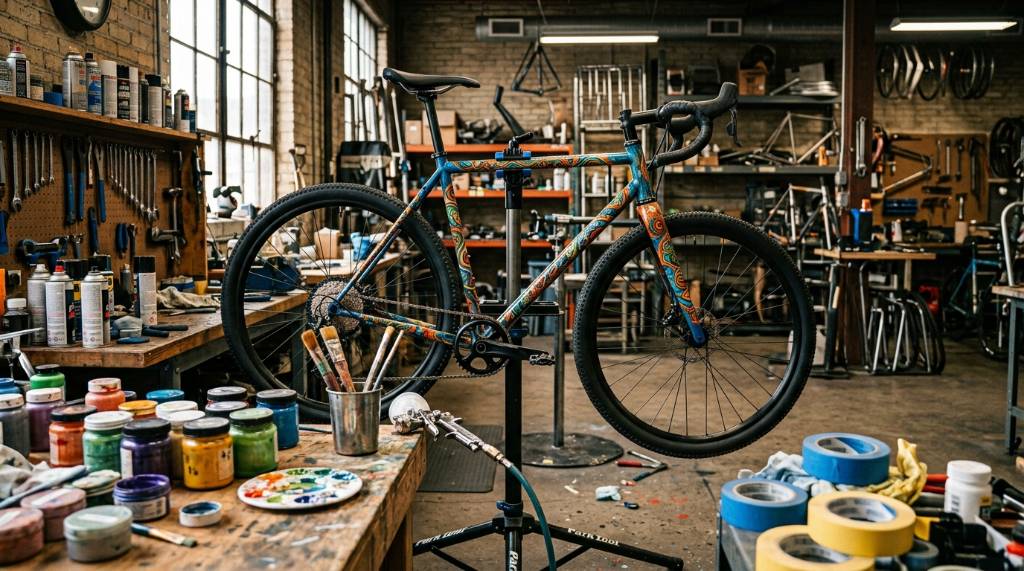
Custom bike frame painting lets you turn an ordinary bicycle into a unique work of art. With the right design, paint, and protective finish, you can create a frame that reflects your style while improving its appearance and durability. This guide explains how to plan your design, prepare the frame, apply paint, and protect the finished bicycle for long-lasting results.
Key Takeaways
- A custom bike paint job is more than choosing a color. Surface preparation, masking, primer, paint application, graphics, clear coat, curing, and final inspection all affect the finished result.
- Carbon fiber frames require particular care because aggressive sanding, blasting, heat, or unsuitable chemicals can damage the underlying composite.
- Wet paint is generally the more flexible option for intricate graphics, gradients, logos, and multi-color designs. Powder coating is primarily associated with compatible metal frames and requires a controlled curing process.
- A quality custom finish should protect the frame while delivering the appearance you want. Ask about preparation, coating system, masking, curing, and quality control before choosing a painter.
- ICAN’s current custom-paint program lets customers choose a compatible frame, select a pattern and colors, customize the logo, submit special requests, and receive a quote. ICAN says its custom frames are hand-painted, so minor color variation can occur.
- For a long-lasting result, treat the painted frame like a premium finish: use appropriate bike-cleaning products, avoid harsh chemicals and abrasive materials, and inspect areas exposed to cable rub, chain slap, and transport damage.
Why Custom Bike Frame Painting Is Worth Considering
Your bike is one of the most visible pieces of equipment you own. After thousands of miles, it can also become part of your identity as a cyclist.
A factory paint scheme may be attractive, but a custom bike frame gives you something different: a finish built around your preferences.
That could mean a subtle satin black frame with matching logos, a classic two-tone road-bike design, a race-inspired graphic, a bright gradient, a metallic finish, or a more artistic pattern. Modern custom-painting services can also incorporate decals, logos, and layered graphics rather than limiting you to a single color.
There is another reason riders choose custom paint: a new finish can make an older frame feel new again. Instead of replacing an otherwise sound frame simply because you no longer like its appearance, refinishing can give it another visual life.
But good custom painting is not simply a matter of spraying color onto carbon or metal. The quality of the preparation underneath the paint is often more important than the color itself.
What Goes Into a Professional Custom Bike Paint Job?
A professional frame-painting process typically involves several stages.
1. Frame selection and design
The first step is deciding what frame will receive the custom finish.
ICAN’s current customization program covers several frame categories, including road, mountain, gravel, cyclocross, and fat-bike frames. The available models and designs can change, so riders should verify current compatibility before ordering.
Once the frame is selected, the design becomes the central decision.
Think about:
- Primary and secondary colors
- Gloss, satin, or matte finish
- Gradients
- Logos and lettering
- Graphic patterns
- Head-tube and down-tube treatment
- Whether exposed carbon should remain visible
- How the frame will coordinate with wheels, bar tape, saddle, and components
A useful rule is to design the whole bicycle, not just the frame. A complicated frame graphic can look fantastic by itself but become visually crowded once wheels, drivetrain components, cables, and accessories are installed.
ICAN’s custom-paint platform allows users to select frames and patterns and preview design choices through its customization interface.
2. Masking and protection
Before paint is applied, areas that should remain unpainted have to be protected.
This is particularly important around:
- Bottom-bracket areas
- Headset and bearing interfaces
- Threaded holes
- Brake-mount interfaces
- Cable-routing openings
- Seatpost and seat-tube interfaces
- Other precision-fit surfaces
Masking is easy to underestimate. A beautiful paint job can still create problems if paint gets onto an interface that needs to remain clean and dimensionally accurate.
ICAN’s published process specifically identifies masking as an early step, followed by cleaning, base coating, top coating, decals, baking, surface finishing, and assembly.
3. Surface preparation
This is where professional work separates itself from a quick DIY repaint.
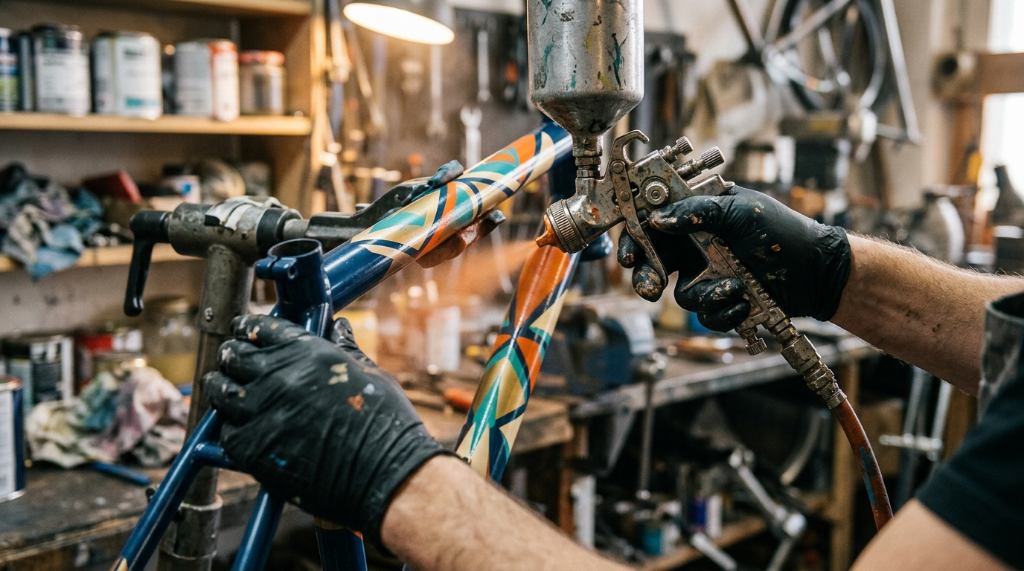
The existing surface must be clean, stable, and properly prepared for the new coating. Depending on the frame and the desired result, preparation can involve cleaning, controlled sanding, removal of unsuitable coatings, filling minor imperfections, and other surface-treatment steps.
For carbon fiber, this stage deserves special attention.
Carbon is not simply a piece of metal with paint on top. The visible surface is part of a composite structure, and unnecessarily aggressive sanding or blasting can create problems. ICAN’s own technical guide recommends careful sanding of carbon and emphasizes avoiding excessive pressure.
Professional bicycle finishers also distinguish between materials. Wet painting can be used across a broad range of frame materials, while powder coating is generally associated with compatible metal frames. One specialist finishing service, for example, specifically describes wet painting as suitable for different materials while recommending powder coating primarily for aluminum and steel frames.
4. Primer and base coat
Primer creates the foundation for the color layers.
A properly prepared primer helps the subsequent paint adhere consistently and can also help create a uniform visual base. The exact primer and application method should depend on the substrate and paint system rather than following a one-size-fits-all recipe.
After primer preparation, the painter applies the base color.
This is also where the quality of the surface becomes obvious. Dust, scratches, contamination, uneven preparation, or poorly repaired imperfections can become much more visible once a glossy color and clear coat are applied.
5. Color, graphics, and custom details
This is the creative stage.
Depending on the design, a custom frame can use:
- Solid colors
- Two-tone combinations
- Multi-color graphics
- Gradients
- Metallic effects
- Chameleon-style finishes
- Decals
- Painted logos
- Hand-painted details
ICAN currently lists a wide range of custom-paint options, including solid colors, gradients, chameleon finishes, and artistic patterns. The company also notes that its custom paint is hand-applied and that slight color differences can occur.
That last point is important. Custom work is not necessarily identical to a mass-produced factory finish. A small amount of variation can be part of the nature of hand-painted work.
If exact color matching matters to you, confirm how the painter handles color references before approving the project.
Wet Paint vs. Powder Coat: Which Is Better?
There is no universal winner.
The right coating depends on the frame material, design, existing finish, desired appearance, and curing requirements.
Wet paint
Wet painting is usually the more versatile choice when the design involves multiple colors, complex graphics, gradients, logos, or fine artistic details.
It is also commonly used for carbon frames.
The major advantage is flexibility: the painter can build a design through multiple layers and finishing stages.
Powder coating
Powder coating applies a dry powder that is subsequently cured under controlled heat.
It can produce a tough, durable finish and is widely used for compatible metal components and frames. However, it is not simply a substitute for wet painting on every bicycle.
Carbon frames are particularly important here. Specialist bicycle finishing services explicitly caution that carbon frames should not be treated like conventional powder-coated metal frames.
If someone recommends powder coating for your frame, confirm that the process is specifically appropriate for that frame material and construction.
Why Carbon Fiber Requires Extra Care
Carbon fiber is one of the most important considerations in modern custom frame painting.
The goal should be to change the cosmetic finish without compromising the underlying composite.
That means the painter needs to understand where it is safe to remove or abrade existing coatings and where it is not. The same caution applies to heat and chemicals.
A frame painter should also understand that precision areas cannot simply be buried under layers of paint.
For example, a bottom-bracket interface, headset bearing seat, brake mount, or threaded opening may need careful masking and post-paint inspection.
This is one reason professional frame painting is different from spraying a household object.
What Does a High-Quality Custom Paint Job Look Like?
Don’t judge a frame only from six feet away.
When evaluating a finished frame, inspect it under strong, even lighting.
Look for:
- Consistent color coverage
- Clean transitions between colors
- Sharp graphic edges
- Smooth clear-coat application
- No obvious runs or sags
- No significant bubbles
- No contamination trapped under the finish
- Clean masking around mounting and interface areas
- Consistent gloss or matte appearance
- Properly positioned logos and decals
ICAN’s published technical material identifies coating adhesion, hardness, surface appearance, and common coating defects as quality considerations. It also references recognized coating tests such as adhesion and pencil-hardness testing.
The exact acceptance criteria, however, should be appropriate to the specific coating system rather than treated as universal bicycle-industry rules.
How Long Does Custom Bike Painting Take?
There is no single turnaround time for every custom frame.
A simple color can require much less work than a complicated multi-layer graphic. The schedule can also depend on frame preparation, curing requirements, artwork approval, workload, and shipping.
For example, ICAN’s current A22 custom-paint listing states an approximate paint time of 20 days and notes that its custom finishes are hand-painted.
That should be treated as a project-specific estimate, not a guarantee for every frame or design.
Before placing an order, ask for:
- Estimated paint-production time
- Design-approval timeline
- Whether the quoted time includes curing
- Shipping time
- Whether delays are possible for complex artwork
How Much Does a Custom Bike Paint Job Cost?
Custom painting prices vary significantly.
The price depends on the frame, preparation required, number of colors, complexity of the artwork, logos, finish, and whether the service includes a frame or paintwork only.
This is one area where it is better not to rely on a generic internet price range.
ICAN’s current service page says customers select their frame, pattern, colors, and other preferences before the team reviews the request and provides a painting quotation.
Also pay attention to an important distinction: the price of custom paint is not necessarily the price of the frame itself.
For example, ICAN’s A22 custom-paint listing explicitly says its displayed price is for custom painting and that the customer should order the corresponding A22 frame separately.
Always confirm exactly what is included.
How to Choose a Custom Bike Painter
Before sending your frame—or ordering one specifically for painting—ask these questions:
Do they regularly paint carbon frames?
Experience with automotive or metal parts does not automatically mean experience with bicycle carbon.
Can they show completed work?
Look for close-up images, not just heavily edited hero shots.
How do they prepare the frame?
A painter should be able to explain the preparation process in understandable terms.
What areas are masked?
Precision interfaces deserve particular attention.
What paint system do they use?
Ask about primer, color coats, clear coat, and curing.
Can they reproduce your design?
A simple color change is very different from a complex geometric or hand-painted design.
How are logos handled?
Find out whether logos are painted, applied as decals, or placed under clear coat.
What happens if the finished color differs from the approved design?
This is especially relevant for hand-painted projects. ICAN specifically warns that slight color variation can occur with hand-painted custom finishes.
What does the warranty cover?
Ask whether the warranty covers paint defects, adhesion problems, structural defects, or only the frame itself.
How to Care for a Custom-Painted Bike Frame
Once the frame is finished, maintenance is relatively straightforward.
Clean the bike regularly rather than allowing road grime, salt, chain lubricant, and other contaminants to accumulate.
Use products appropriate for bicycle finishes and avoid aggressive solvents unless the frame manufacturer or paint provider specifically approves them.
A few habits can make a major difference:
- Wash with a soft cloth or sponge.
- Avoid abrasive brushes on painted surfaces.
- Don’t pressure-wash directly into bearings, seals, or interfaces.
- Clean chain lubricant from the frame promptly.
- Check high-contact areas for cable or housing rub.
- Use frame protection where repeated rubbing is expected.
- Inspect the finish after transporting the bike.
- Don’t use abrasive polishing products on matte finishes unless specifically approved.
Remember that the paint is cosmetic protection, not structural repair. If you discover a crack, impact damage, delamination, or another suspected structural problem, stop riding and have the frame evaluated by an appropriately qualified professional.
Is Custom Frame Painting Right for You?
Custom painting makes the most sense when appearance and personalization matter enough to justify the additional time and cost.
It can be an excellent choice for:
- A dream-bike build
- A race bike you plan to keep for years
- A milestone or commemorative bicycle
- A restoration project
- A matching bike-and-component aesthetic
- Riders who want something different from standard factory colors
It may be less attractive if you change bikes frequently, are highly concerned about resale originality, or simply want a temporary color change. In those cases, removable graphics or wraps may deserve consideration.
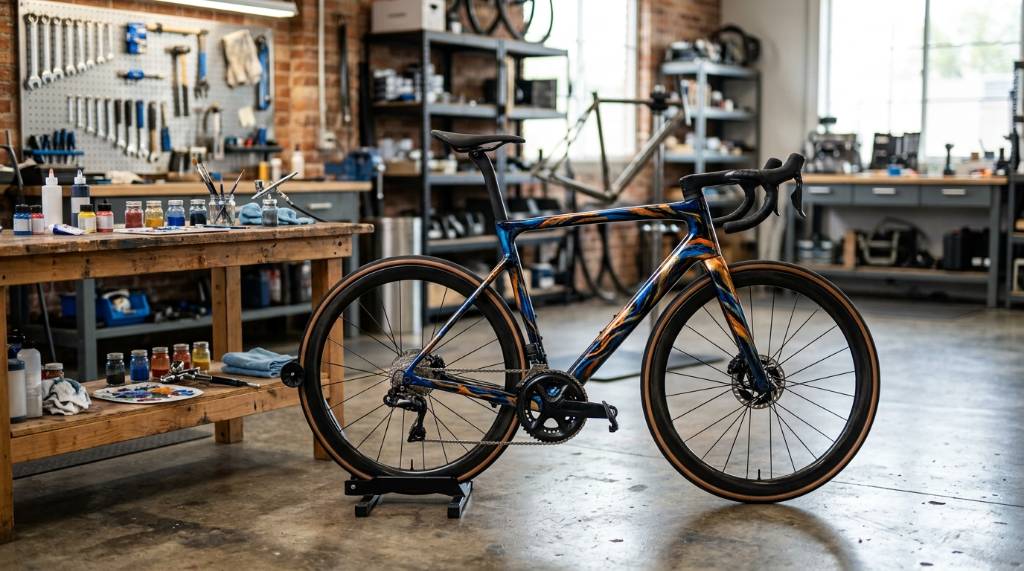
The best custom paint is ultimately the result of matching the right design to the right frame and the right finishing process.
ICAN’s Custom Bike Frame Painting Process
ICAN’s current program follows a straightforward customization path:
Choose the frame → choose the pattern → select colors → choose logo treatment → add special instructions → request a quote.
Its separate customization platform also provides an interactive way to select a frame, explore patterns, choose glossy or matte treatment, and customize certain components and logo options.
For riders considering an ICAN/TRIAERO frame, this approach has one obvious advantage: the frame and paint process can be planned together instead of taking an existing frame to an unrelated refinishing shop.
ICAN also publishes examples of its production process, including preparation, sanding, cleaning, primer, paint, protective coating, decals, inspection, and assembly. Its 2025 process video provides additional first-hand evidence of how its team approaches carbon-frame finishing.
Frequently Asked Questions
Can you custom paint a carbon bike frame?
Yes, carbon frames can be custom painted, but the process requires appropriate preparation and materials. Carbon should not be treated like ordinary steel or aluminum because excessive sanding, unsuitable blasting, chemicals, or heat can create problems.
Is painting a bike frame safe?
A properly controlled professional painting process can be safe for the frame when the coating system and preparation methods are compatible with the frame material. The critical issue is avoiding damage to the underlying structure and maintaining precision interfaces.
Can you powder coat a carbon bike frame?
Powder coating should not be assumed to be suitable for carbon. Powder coating involves heat curing, and specialist bicycle finishers commonly recommend other finishing methods for carbon frames.
Will custom paint make my bike heavier?
Paint adds some mass, but the amount depends on the coating system and how much material is applied. A professional painter should control coating thickness rather than applying unnecessarily heavy layers.
Can I choose any color?
That depends on the painter’s available paint systems and design options. ICAN currently offers multiple color categories, gradients, chameleon finishes, and artistic patterns, but available options can change.
Can I submit my own design?
You can ask a custom painter whether your artwork can be reproduced. ICAN’s service specifically allows customers to leave special requests and communicate their desired concept before receiving a quotation.
How long does custom bike painting take?
It depends on the design and service. ICAN currently lists approximately 20 days for the A22 custom-paint service, but individual projects can differ.
Should I paint my existing bike or order a new frame with custom paint?
If your existing frame is structurally sound and you love its geometry and fit, refinishing can make sense. If you’re already planning a new build, ordering a compatible frame with custom paint can simplify the process because the design and frame are handled together.
Final Thoughts
A custom bike frame should be treated as both a design project and a technical finishing project.
The colors get most of the attention, but preparation, masking, coating compatibility, curing, clear-coat quality, and final inspection determine whether the finished frame actually looks professional.
For carbon frames in particular, the safest approach is to work with a painter who understands composite construction rather than treating the frame like a generic metal object.
If you’re considering ICAN’s custom-paint program, start by choosing the frame and creating a clear design brief. Think about the colors, finish, graphics, logo treatment, and how the completed frame will look with the rest of your build. Then confirm the current production time, quotation, included services, and warranty terms before approving the project.
A great custom paint job should do more than make your bike different. It should make you want to ride it every time you see it.