
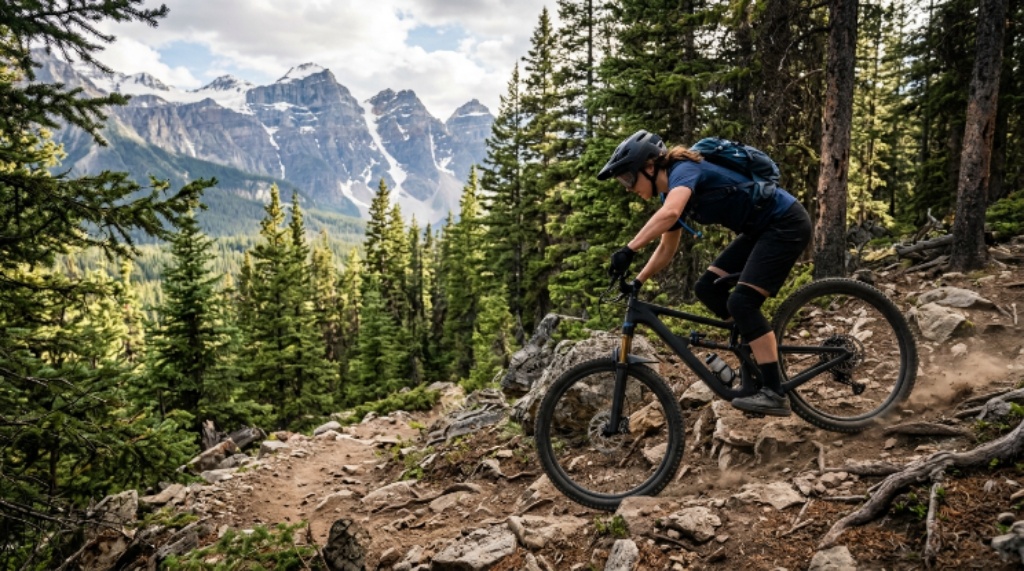
Shopping for a mountain bike in 2026 is less about finding one universally “best” model and more about finding the right bike for the trails you actually ride. A fast cross-country bike can be a blast on rolling singletrack but feel nervous when the trail turns steep and rocky. An enduro bike can bulldoze rough descents but feel unnecessarily heavy on mellow weekend rides. And a modern trail bike sits somewhere in the middle, offering the broadest range of capability for riders who want one bike to handle almost everything.
That is why this guide takes a different approach. Instead of treating every mountain bike as interchangeable, we look at the major categories and explain who each type is really for.
Our research includes current 2026 testing from established mountain-bike publications, the latest available manufacturer specifications, and developments in suspension, geometry, drivetrains, wheel sizes and e-MTB technology. One important distinction: the popular OutdoorGearLab guide that inspired this update is still useful for its hands-on testing, but its page was last updated April 14, 2025 despite carrying a 2026 title.
Key Takeaways
- Best all-around choice: Ibis Ripmo V3 remains an outstanding option for riders who want serious climbing and descending capability from one bike.
- Best versatile mid-travel option: Revel Rascal offers an efficient, highly capable trail-bike platform for riders who value all-around performance.
- Best aggressive trail choice: Santa Cruz Hightower is aimed at riders who spend more time on steep, rough terrain.
- Best short-travel option: Trek Top Fuel makes a strong case for riders who prioritize speed, climbing efficiency and playful handling.
- Best value full-suspension bike: Canyon Neuron 5 offers a balanced trail package without requiring a premium-bike budget.
- Best budget-focused trail bike: Norco Fluid FS 4 is unusually capable for its price class.
- Best XC direction: Modern XC bikes increasingly blend racing efficiency with enough travel and geometry to handle technical recreational riding.
- Best e-MTB direction: The 2026 Specialized Turbo Levo 4 shows how full-power electric mountain bikes are becoming legitimate trail-bike alternatives rather than niche products.
- Most important buying advice: Fit and intended terrain matter more than having the most expensive drivetrain or carbon frame.
Our Top Mountain Bike Picks for 2026
| Category | Recommended bike | Best for |
| Best overall trail bike | Ibis Ripmo V3 | Riders wanting one high-performance bike for climbing and descending |
| Best mid-travel trail bike | Revel Rascal | Versatile trail riding |
| Best aggressive trail bike | Santa Cruz Hightower | Rough, technical trails |
| Best short-travel trail bike | Trek Top Fuel | Fast trail riding and climbing |
| Best value full-suspension | Canyon Neuron 5 | Recreational riders and moderate terrain |
| Best budget trail bike | Norco Fluid FS 4 | Riders who want capability without spending $4,000+ |
| Best full-power e-MTB | Specialized Turbo Levo 4 | Long, steep and demanding rides with motor assistance |
| Best fat-bike option | Fezzari Kings Peak Comp | Snow, sand and mixed-surface adventure |
Ibis Ripmo V3 — Best Overall Trail Mountain Bike
The Ibis Ripmo V3 is the easiest recommendation for an experienced rider who wants one bike capable of handling a remarkably wide range of terrain.
OutdoorGearLab’s testing gave the Ripmo V3 GX AXS its overall trail-bike honors, highlighting its combination of climbing ability, high-speed stability and descending performance. The tested model uses 29-inch wheels and 150mm of rear travel.
What makes the Ripmo especially compelling is that it does not behave like a lumbering enduro bike simply because it has substantial travel. Its geometry and suspension design give it enough efficiency to make long climbs manageable while preserving confidence when the trail points downward.
The V3 also demonstrates where premium trail bikes are heading: size-specific geometry, frame storage, modern wheel compatibility and suspension designed around real-world riding rather than simply chasing a travel number.
Best for: Experienced trail riders, aggressive all-mountain riders and anyone looking for a high-end “one-bike garage.”
Watch out for: Weight and price. You are paying for performance that a casual rider may never fully exploit.
Revel Rascal — Best Mid-Travel Trail Bike
The Revel Rascal is a different interpretation of the modern trail bike.
OutdoorGearLab lists the Rascal XO Transmission as its best mid-travel trail bike, with 29-inch wheels and 130mm of rear travel. Its testers praised its versatility, suspension performance and wheel package, while identifying its premium price and non-adjustable geometry as drawbacks.
This is the kind of bike that makes sense when your rides routinely include long climbs, technical singletrack and plenty of undulating terrain.
Its relatively moderate travel also illustrates an important 2026 trend: riders do not necessarily need huge suspension numbers to ride difficult trails. Efficient suspension and thoughtful geometry can make a moderately traveled bike feel much more capable than the specification sheet suggests.
Best for: Riders who want a responsive trail bike rather than an enduro-style bruiser.
Santa Cruz Hightower — Best Aggressive Trail Bike
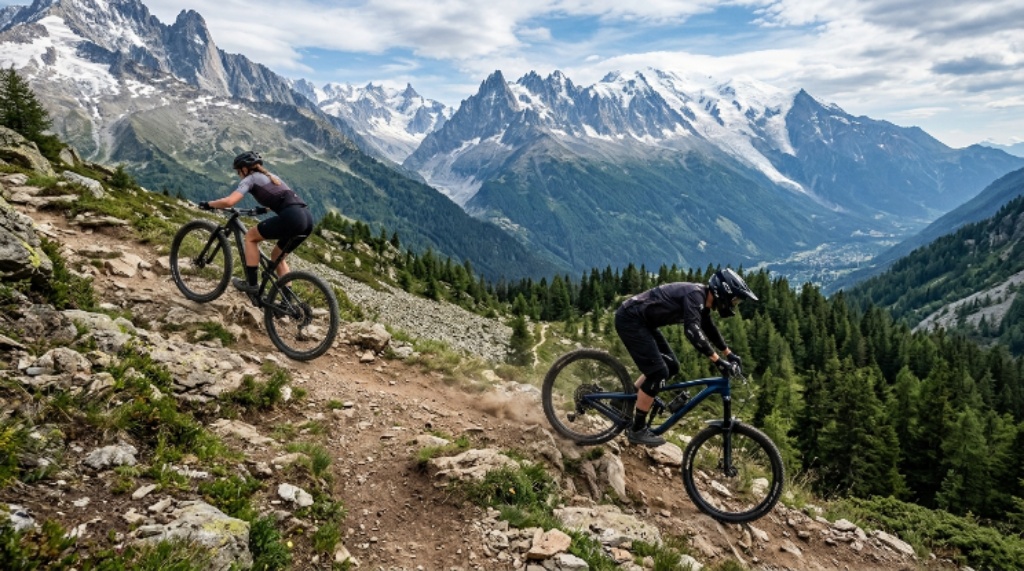
If your idea of mountain biking involves steep descents, rock gardens, technical corners and bigger hits, the Santa Cruz Hightower deserves serious attention.
The Hightower 90 in OutdoorGearLab’s test uses 150mm of rear travel and weighs about 34 pounds in a large. Testers highlighted its fourth-generation VPP suspension, integrated glove-box storage and adjustable geometry.
The Hightower occupies a useful middle ground. It has enough suspension and stability for aggressive riding without becoming a dedicated downhill or enduro machine.
That makes it particularly attractive to riders whose local trails are rough but who still have to pedal to the top.
Best for: Aggressive trail riders and riders living near mountainous terrain.
Consider instead: A shorter-travel bike if most of your rides are smooth, rolling singletrack.
Trek Top Fuel — Best Fast and Efficient Trail Bike
The Trek Top Fuel proves that a trail bike does not need enormous suspension travel to be fun.
The Top Fuel 9.8 GX AXS Gen 4 tested by OutdoorGearLab has 120mm of rear travel, while Trek’s specification allows a 130mm fork and up to 140mm of compatible fork travel. It also offers adjustable geometry through Trek’s Mino Link system and supports multiple wheel configurations depending on frame size.
That combination makes the Top Fuel particularly interesting for riders who want to climb efficiently but still enjoy technical descents.
Its relatively low weight and efficient chassis are especially useful if your rides involve lots of elevation gain.
Best for: Fast trail riding, long climbs, XC-style riding with additional descending capability and riders who dislike sluggish bikes.
Canyon Neuron 5 — Best Value Full-Suspension Trail Bike
The Canyon Neuron 5 is one of the clearest examples of how much mountain bike performance is available below the premium-bike price bracket.
There is, however, an important update to the original article: OutdoorGearLab’s version lists the Neuron 5 at $1,799, while Canyon’s current U.S. listing shows $2,499. Canyon currently specifies a 140mm fork, a 33.52-pound weight in size M, four-piston brakes and Shimano Deore shifting.
The Neuron is deliberately less extreme than many modern trail bikes. Canyon emphasizes intuitive handling and balanced geometry rather than making the bike excessively long and slack. Sizes XS and S use 27.5-inch wheels, while M through XL use 29-inch wheels.
That is a significant advantage for newer riders. A bike that remains predictable at moderate speeds can be more enjoyable than an ultra-slack machine that only comes alive when you are charging downhill.
Best for: Beginners moving into full suspension, recreational trail riders and anyone prioritizing value.
Norco Fluid FS 4 — Best Budget Trail Bike
The Norco Fluid FS 4 is proof that a lower price does not automatically mean a mountain bike has to feel primitive.
OutdoorGearLab found the Fluid FS 4 surprisingly competent on difficult terrain, praising its stability at speed, confidence on steep trails and long-travel dropper post. The principal complaints were weight and the lack of a climb switch on the rear shock.
For a budget buyer, those trade-offs are reasonable.
A heavier bike with good suspension, appropriate geometry and a useful dropper post is usually a better trail companion than a lighter bike with poor suspension and outdated geometry.
Best for: New mountain bikers, budget-conscious riders and people who want a capable first full-suspension bike.
Specialized Turbo Levo 4 — Best Full-Power E-MTB Direction
A modern mountain-bike guide cannot realistically ignore e-MTBs.
The current Specialized Turbo Levo 4 is a good example of how far the category has evolved. The current U.S. lineup includes 160mm front and 150mm rear travel, an 840Wh battery and up to 850W peak power and 111Nm of torque on higher-spec versions. The aluminum Levo 4 starts at $4,999.99.
Independent 2026 testing of the Turbo Levo 4 found it particularly strong as an all-round e-MTB, with composed climbing, confident descending and a broad performance envelope.
The key question is not whether an e-MTB is “better” than an analog bike. It is whether motor assistance matches the way you ride.
If you want to ride farther, climb more elevation, keep up with faster groups or reduce the physical barrier of long climbs, an e-MTB can completely change the experience.
Best for: Long-distance trail riding, steep terrain, riders with limited climbing time and people who prioritize maximizing trail time.
Fezzari Kings Peak Comp — Best Fat Bike for Adventure
Fat bikes are a specialized category, but they still have a place in a comprehensive mountain-bike guide.
The Kings Peak Comp uses 27.5 x 4.5-inch tires and was praised by OutdoorGearLab for its modern geometry, relatively reasonable price and extensive mounting options.
Its real advantage appears when conventional mountain-bike tires are at a disadvantage—particularly snow, sand and other soft surfaces.
Do not buy one simply because it looks like an oversized mountain bike. Buy it because your riding conditions justify the huge tires.
How to Choose the Right Mountain Bike
Start with your trails, not the brand
Think about the terrain you ride most often.
Mostly smooth and rolling: Consider an XC or short-travel trail bike.
Mixed singletrack: A 120–140mm trail bike is often the sweet spot.
Steep and technical: Look toward 140–160mm trail bikes or aggressive all-mountain models.
Bike parks and very rough terrain: An enduro bike makes more sense.
Snow and sand: A fat bike is the specialized solution.
Long climbs or limited riding time: Consider an e-MTB.
The biggest mistake is buying a bike for the terrain you wish you rode instead of the terrain you actually ride.
How much suspension travel do you need?
Travel is useful, but more is not automatically better.
A short-travel bike generally pedals more efficiently and can feel lively on rolling terrain. More travel gives you greater margin for error on rough descents, but it can add weight and reduce responsiveness.
As a rough starting point:
- 100–120mm: XC and fast trail riding
- 120–140mm: General trail riding
- 140–160mm: Aggressive trail and all-mountain
- 160mm+: Enduro and gravity-oriented riding
These ranges overlap heavily. Suspension design, geometry, frame stiffness, tires and setup can matter just as much as the travel number.
29-inch vs. 27.5-inch wheels
29-inch wheels are now dominant on many modern mountain bikes because they roll efficiently over obstacles and maintain momentum well.
Smaller wheels can still make sense for shorter riders, riders who want a more playful feel, or bikes specifically designed around mixed-wheel setups.
The Canyon Neuron 5 is a useful example of the current approach: XS and S use 27.5-inch wheels while M through XL use 29-inch wheels.
Don’t choose a wheel size based solely on what looks fastest. Frame fit and rider proportions come first.
Carbon or aluminum?
Carbon is lighter and can offer excellent stiffness-to-weight performance, but it is expensive.
Aluminum frames have become extremely good. For many riders, spending less on the frame and putting the savings toward better suspension, brakes, wheels or tires produces a better real-world bike.
If your budget is limited, prioritize fit, suspension quality, brakes, tires and a dropper post before obsessing over carbon.
Don’t underestimate the dropper post
A dropper post is one of the most meaningful upgrades on a modern mountain bike.
Lowering the saddle on descents gives you more room to move around the bike and lowers your center of mass. That can make steep and technical terrain significantly easier to manage.
OutdoorGearLab similarly identifies the dropper as one of the most valuable features to prioritize when comparing builds.
If two bikes are similarly priced and one has a substantially better dropper, brakes or suspension, that difference may matter more than a slightly nicer drivetrain.
Mechanical vs. electronic shifting
Wireless electronic shifting is polished, but it is not essential.
Modern mechanical systems remain highly functional, inexpensive to maintain and easy to service.
SRAM’s newer Eagle 70 and Eagle 90 Transmission systems are particularly interesting because they bring the company’s Full-Mount architecture into mechanical drivetrains, emphasizing durability and shifting under load.
In other words, 2026 is not simply a story of everything becoming electronic. Mechanical technology is improving, too.
What Is Changing in Mountain Bikes in 2026?
One of the most interesting shifts is that mountain-bike design appears to be moving away from the simplistic “longer, lower and slacker” philosophy.
Recent industry commentary suggests manufacturers are increasingly refining geometry rather than endlessly stretching frames and slackening head angles. Tire technology, frame modularity and fit are receiving more attention as designers search for practical improvements.
At the same time, 32-inch wheels are beginning to appear in the market, particularly around XC-oriented development. That does not mean 29-inch bikes are suddenly obsolete; rather, it shows that wheel-size experimentation is continuing.
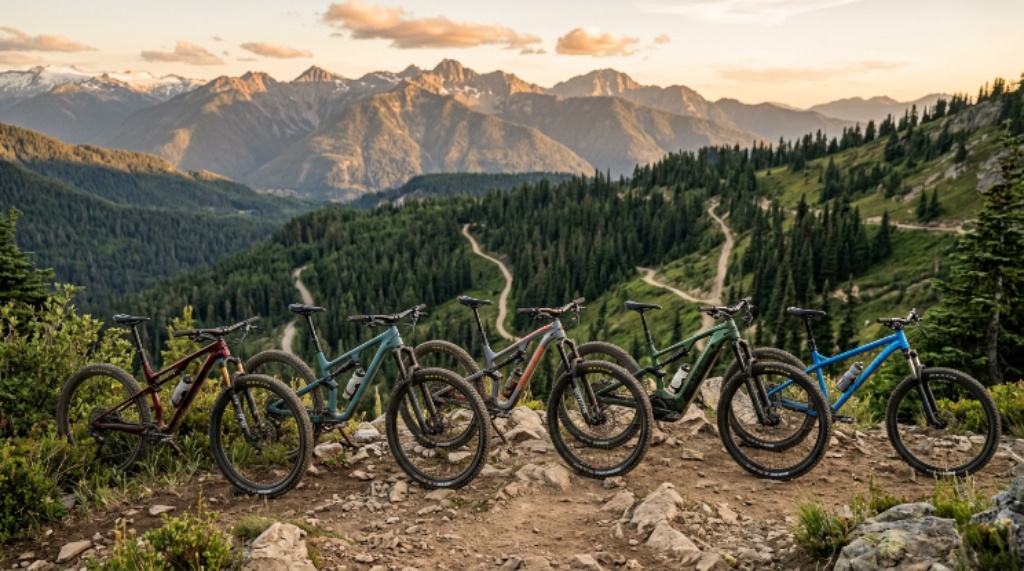
The other major development is electrification. Full-power e-MTBs are increasingly sophisticated, while lightweight e-MTBs aim to preserve more of the handling feel of conventional bikes. The current Levo family, for example, spans full-power, aggressive and lightweight-oriented configurations.
For buyers, this is good news. There are more genuinely distinct choices than ever.
Mountain Bike Buying Mistakes to Avoid
Buying too much bike
A $7,000 enduro bike is not automatically better than a $2,500 trail bike. If you ride mellow trails, you may actually have more fun on the cheaper, lighter bike.
Choosing based on components alone
A premium derailleur cannot compensate for a poorly fitting frame.
Ignoring tires
Tires dramatically affect grip, rolling resistance, braking and cornering. A bike with mediocre tires can feel completely different after a tire upgrade.
Choosing the wrong size
Do not assume your height alone determines your frame size. Reach, stack, seat-tube length, inseam, riding position and manufacturer-specific geometry all matter.
Ignoring serviceability
A great bike that is difficult to service locally can become a headache. This is especially relevant when comparing consumer-direct brands with bikes sold through local dealers.
Spending the entire budget on the bike
Leave room for a helmet, shoes, pedals, tools, tubeless setup, spare parts and basic suspension service.
Frequently Asked Questions
What is the best mountain bike overall in 2026?
For an experienced rider seeking a high-performance bike capable of handling both climbs and demanding descents, the Ibis Ripmo V3 is one of the strongest all-around choices. OutdoorGearLab’s hands-on testing specifically praised its balance of climbing efficiency and descending performance.
Is a 29er better than a 27.5 mountain bike?
Not universally. A 29er generally offers strong rollover and momentum, while 27.5-inch wheels can provide a more compact, playful feel and may suit shorter riders. Modern bikes increasingly use size-specific wheel strategies rather than forcing every rider onto one wheel size.
How much should I spend on my first mountain bike?
For a serious first full-suspension bike, the sweet spot is often around the $2,000–$3,000 range, although excellent hardtails can cost considerably less. Spending more makes sense when you understand what you need and can benefit from better suspension, wheels, brakes and drivetrain components.
Is full suspension worth it for beginners?
If you regularly ride rocky, rooty or technical trails, yes. Full suspension provides more traction and comfort and can make difficult terrain more forgiving. For smooth trails and beginners on a tight budget, a quality hardtail can be the smarter purchase.
Is an e-MTB worth buying in 2026?
For the right rider, absolutely. The latest full-power e-MTBs offer substantial range and assistance while retaining sophisticated suspension and geometry. But they are heavier and more expensive than comparable analog bikes, and some riders simply prefer the physical challenge of an unassisted bike.
Do I need a carbon mountain bike?
No. Carbon can save weight and deliver excellent performance, but a well-designed aluminum bike can be an outstanding choice. If your budget is limited, spend your money where you can feel it on the trail: suspension, tires, brakes, wheels and fit.
What suspension travel is best for trail riding?
For general trail riding, roughly 120–140mm of rear travel is an excellent starting point. Riders on particularly rough terrain may prefer 140–160mm, while XC riders may want less.
Are expensive mountain bikes worth it?
Only if you can use their advantages. Premium bikes often provide better suspension, lighter wheels, higher-end drivetrains and more sophisticated frame construction. But those improvements become less important as riding intensity decreases.
The Bottom Line
There is no single mountain bike that is best for every rider.
The modern trail bike is probably the safest starting point for most people because it balances climbing, descending, comfort and versatility. The Ibis Ripmo V3 represents the high-performance end of that philosophy, while bikes such as the Revel Rascal and Trek Top Fuel show how different interpretations of the trail-bike category can work. For value shoppers, the Canyon Neuron 5 and Norco Fluid FS 4 demonstrate how capable less-expensive bikes have become.
If your trails are especially aggressive, move toward a longer-travel platform such as the Hightower. If you race cross-country or prioritize speed and efficiency, look toward XC bikes. And if your priority is maximizing distance and climbing ability, the increasingly sophisticated e-MTB market deserves serious consideration.
The most important upgrade, however, is still the same one it has always been: buy the bike that fits your body, matches your trails and makes you want to ride more often.
You may also like
-
How to Create a Custom Build Inspired by Hutch BMX Classics
-
How to Ride a Very Velo Bike Efficiently on Hilly Roads
-
How to Choose MTB Frame Size: The Ultimate Guide for Mountain Bikers
-
Bike Types Explained: Road, MTB, Gravel & More
-
Choosing the Best Bike Type for Your Ride: Expert Picks for Every Terrain And Lifestyle