

A good hardtail mountain bike can be one of the smartest purchases in mountain biking. You get a suspension fork, wide tires, hydraulic disc brakes and modern trail geometry, but without the rear shock, linkage and extra bearings found on a full-suspension bike.
That simplicity matters. Hardtails are generally lighter, easier to maintain and less expensive than comparable full-suspension bikes. They also teach you to choose better lines because the rear wheel doesn’t have suspension to smooth out every mistake.
But here’s the catch: not every hardtail is designed for the same job.
A lightweight XC hardtail can be fantastic for climbing and long-distance riding but feel nervous on steep, rocky descents. An aggressive trail hardtail can be incredibly capable downhill but feel slower and heavier when you’re covering miles. And a cheap recreational MTB may look similar to both, while having a much less capable fork, wheels or drivetrain.
We’ve therefore approached this guide from a different angle: instead of simply asking which hardtail is “best,” we’re looking at which bike makes the most sense for a particular rider.
Key Takeaways
- Best overall trail hardtail: Orbea Laufey H10
- Best XC-focused hardtail: Specialized Chisel Comp
- Best premium all-rounder: Ibis DV9
- Best value trail hardtail: Giant Fathom 29
- Best aggressive hardtail: Canyon Stoic
- Best choice for beginners: Giant Fathom 29 or a similarly equipped modern trail hardtail
- Choose 29-inch wheels if you prioritize rolling speed, stability and obstacle clearance.
- Choose 27.5-inch wheels when maneuverability and a smaller frame fit are more important.
- A dropper post is one of the most worthwhile upgrades for trail riding.
- On a hardtail, the fork, tires and brakes matter more than flashy drivetrain upgrades because they’re doing much of the work of controlling the bike.
- If your local trails are consistently rocky, steep and fast, consider whether a full-suspension bike would ultimately suit you better.
Our Top Hardtail Mountain Bikes for 2026
Orbea Laufey H10 — Best Overall Trail Hardtail
The Orbea Laufey H10 is the kind of bike that makes a strong case for buying a hardtail instead of treating one as a budget substitute for full suspension.
Its geometry is decidedly trail-oriented. The current Laufey H10 uses a 140mm Fox 34 AWL fork, a 64.5-degree head angle, a 77-degree seat angle and 29-inch wheels. It also has clearance for tires up to 2.6 inches and comes equipped with a dropper post.
That combination gives the Laufey a very different personality from a traditional XC hardtail.
It is built to descend confidently, carry speed through rough sections and remain playful rather than simply trying to shave every possible gram from the frame.
The short, straight seat tube is particularly useful because it allows a long-travel dropper post to be inserted deeply into the frame. That’s a meaningful advantage on technical trails where getting the saddle completely out of the way can make a bigger difference than another gear or a lighter crankset.
Best for: Trail riding, technical singletrack, aggressive beginners and experienced riders who want a hardtail that can handle rough terrain.
Watch out for: Its aggressive geometry isn’t the fastest choice if your priority is XC racing or long pavement-heavy rides.
Specialized Chisel Comp — Best XC Hardtail
If your definition of mountain biking involves climbing efficiently, covering serious mileage and attacking fast singletrack, the Specialized Chisel Comp deserves a close look.
The current Chisel is designed around modern cross-country geometry and uses a 120mm RockShox SID fork, 29-inch wheels and a 12-speed SRAM GX drivetrain. It also comes standard with a TranzX dropper post, tubeless-ready wheels and hydraulic disc brakes.
The geometry is noticeably more XC-oriented than the Laufey. The Chisel has a 68-degree head angle and a 74-degree seat angle, giving it a quicker, more efficient character while retaining enough modern geometry for serious trail use.
This is an important distinction when shopping for a hardtail.
More suspension travel isn’t automatically better. If you’re riding rolling trails and spending a lot of time climbing, a lighter 120mm XC hardtail can be more enjoyable than a heavy 140mm trail machine.
Best for: XC riding, fitness, marathon rides, fast singletrack and riders who value climbing efficiency.
Watch out for: Riders who spend most of their time on steep, technical descents may prefer a slacker trail hardtail.
Ibis DV9 — Best Premium All-Rounder
The Ibis DV9 sits in an interesting middle ground.
It’s a carbon hardtail with a 120mm fork, 29-inch wheels, 148mm rear spacing and clearance for tires up to 2.6 inches. The current V2 frame weighs about 1,305g in a size large, according to Ibis.
Its 66.5-degree head angle and 425mm chainstays give the bike a playful personality without pushing it into full-on hardcore-hardtail territory. Ibis describes the DV9 as a bike capable of everything from trail riding to racing and pump-track sessions.
That’s exactly why it stands out.
A carbon frame can make sense when you’re trying to combine low weight with a lively ride feel, and the DV9’s geometry gives it enough capability for more aggressive riding than its XC-style 120mm fork might initially suggest.
Best for: Experienced riders, fast trail riding, XC/trail crossover and anyone who wants a premium carbon hardtail.
Watch out for: The price. A carbon hardtail only makes financial sense if you value its weight and ride characteristics enough to justify the premium.
Giant Fathom 29 — Best Value Trail Hardtail
The Giant Fathom 29 is a particularly appealing option for riders who want a serious trail bike without moving into premium-bike pricing.
The current Fathom 29 uses an ALUXX SL aluminum frame, a 130mm Giant Crest 34 fork, 29-inch wheels, 2.5-inch tubeless tires and a dropper seatpost. Its geometry includes a 66-degree head angle and 75-degree seat angle.
That specification tells you exactly where this bike sits in the market.
It’s not a stripped-down recreational MTB, and it’s not an XC race bike. It’s a modern trail hardtail intended to be ridden aggressively on real singletrack.
The 2.5-inch tires are especially useful because hardtails rely heavily on tire volume for comfort and traction. Since there is no rear shock to absorb impacts, tire choice and pressure have a disproportionately large effect on ride quality.
Best for: Beginners moving into real trail riding, recreational riders, technical singletrack and riders seeking strong equipment for the money.
Watch out for: Riders focused primarily on racing may want something lighter and more XC-oriented.
Canyon Stoic — Best Aggressive Hardtail
The Canyon Stoic is aimed at riders who don’t want their hardtail to behave like an XC bike.
Canyon positions the Stoic as a robust trail hardtail with geometry intended for technical trails, jumps and pump tracks. The platform sits closer to the aggressive end of the hardtail spectrum than the Grand Canyon or Exceed.
The Stoic range has historically used 140mm forks on medium-to-XL 29er frames, with smaller sizes using 27.5-inch wheels and different fork travel. Canyon’s current hardtail guidance also puts aggressive trail hardtails around the 140mm range, compared with roughly 100mm for XC-oriented models.
That distinction is useful when comparing bikes.
If your weekend riding includes steep chutes, jumps, rock gardens and technical descents, the Stoic-style approach makes more sense than buying an ultralight XC hardtail simply because it has a better drivetrain.
Best for: Aggressive trail riding, jumps, technical terrain and riders who prioritize descending.
Watch out for: It won’t be as efficient as an XC hardtail on long climbs or endurance-oriented rides.
Hardtail vs. Full Suspension: Which Should You Buy?
The simplest answer is this:
Buy a hardtail if you value efficiency, simplicity, lower maintenance and a direct connection to the trail. Buy full suspension if comfort, traction and control on rough terrain are your priorities.
A hardtail has fewer moving parts, so there is less suspension hardware to maintain. It is also typically lighter and less expensive. Canyon’s current buying guide highlights the same advantages, noting that hardtails provide lower weight, lower entry prices and reduced maintenance compared with full-suspension bikes.
The trade-off becomes obvious on rough descents.
A full-suspension bike can keep the rear tire planted over rocks and roots while reducing the amount of impact reaching the rider. That can mean more grip, less fatigue and greater control when trails become extremely rough.
A hardtail, by contrast, makes you work with the terrain.
For some riders, that’s exactly the point.
What Should You Look for in a Hardtail?
Start With the Geometry
Don’t buy a mountain bike based solely on the number of gears or the brand of derailleur.
Geometry determines how the bike behaves.
A steeper head angle generally produces quicker steering and suits XC riding. A slacker head angle generally increases stability on steep descents.
Similarly, a steep seat angle helps position the rider efficiently over the pedals for climbing, while longer reach and a longer wheelbase can provide additional stability.
There is no universally perfect geometry. The right numbers depend on how you ride.
Pay Close Attention to the Fork
On a hardtail, the fork is arguably the most important suspension component because it’s the only suspension component.
For XC riding, around 100–120mm of travel is common. Trail-oriented hardtails frequently move into the 120–140mm range, while more aggressive designs can go beyond that. Canyon’s current guide places typical hardtail fork travel between approximately 80mm and 150mm depending on intended use.
An air-sprung fork is usually preferable because you can adjust its spring rate to your weight and riding style.
Don’t Underestimate Tires
Tires are part of the suspension system on a hardtail.
A wider tire gives you more air volume, which can allow lower pressures and improve grip and comfort. Tubeless setups can further reduce pinch-flat risk and allow riders to fine-tune pressure for their terrain.
For general trail riding, a 2.4–2.6-inch tire can be an excellent starting point if the frame and wheels support it.
For XC, narrower and faster-rolling tires can save energy.
Get a Dropper Post
If you’re riding technical trails, a dropper post should be high on your priority list.
Lowering the saddle on descents lets you move your hips backward and shift your body more freely. That improves confidence and control, particularly when the trail suddenly becomes steep.
Several current trail hardtails, including the Laufey and Fathom, come with dropper posts from the factory.
Look for Hydraulic Disc Brakes
Hydraulic disc brakes provide strong, consistent braking with relatively little lever effort.
Two-piston brakes are perfectly adequate for many XC and recreational applications. Four-piston systems make more sense for aggressive riding and heavier riders, particularly when paired with larger rotors.
Don’t assume that the most expensive drivetrain automatically means the best bike. For trail riding, I’d generally prioritize fork quality, tires, wheels, brakes and a dropper before spending extra money for a higher-level drivetrain.
29 vs. 27.5-Inch Wheels
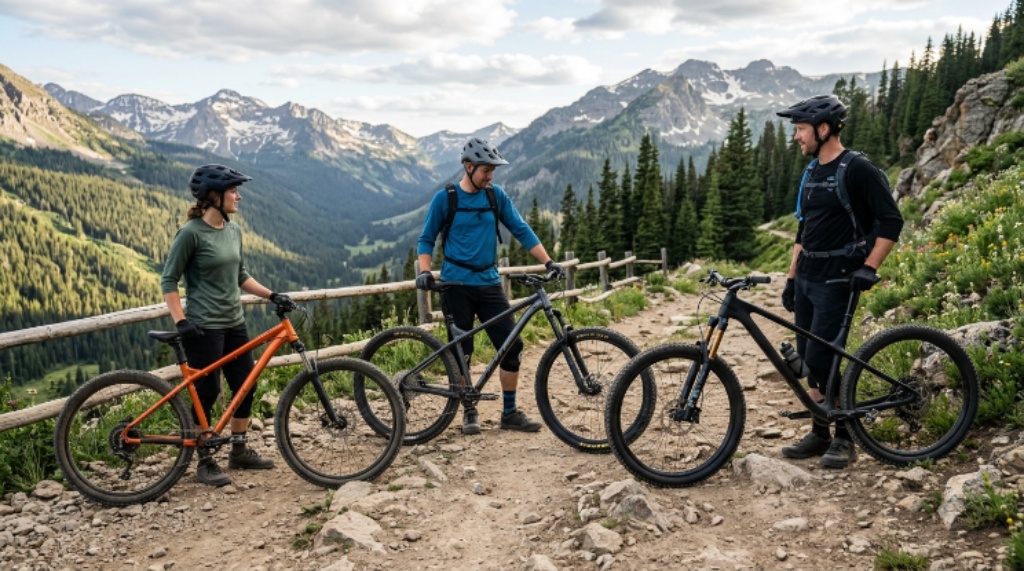
For most adult trail riders, 29-inch wheels are the default choice in 2026.
They roll over rocks, roots and other obstacles more easily and generally provide good stability and momentum. Canyon also notes that 29-inch wheels are particularly common for XC and trail riding.
A 27.5-inch bike can still make sense.
Smaller riders may find the proportions more natural, while riders who prioritize quick handling and playful behavior may prefer the smaller wheel.
Some manufacturers also mix wheel sizes on aggressive hardtails, creating a “mullet” setup with a 29-inch front wheel and 27.5-inch rear wheel.
How Much Should You Spend?
There’s no magic price that guarantees a good hardtail.
Instead, think about where the money goes.
At the lower end of the market, prioritize:
- Hydraulic disc brakes
- A usable suspension fork
- Modern frame geometry
- A 1x drivetrain
- Thru-axles if possible
- Tubeless-ready wheels
- Dropper-post compatibility
As the budget increases, you should start seeing better forks, stronger wheels, better brakes, lighter frames and more refined geometry.
At the premium end, carbon frames and high-end components can produce extremely lightweight bikes. But spending several thousand dollars on a hardtail doesn’t automatically make sense for every rider. Once the price climbs significantly, it’s worth comparing the bike against a capable full-suspension model.
The Bottom Line
The best hardtail mountain bike isn’t necessarily the lightest, most expensive or most aggressively specced model.
It’s the bike whose geometry, suspension and components match your trails.
For a versatile trail bike, the Orbea Laufey H10 is one of the strongest choices because its 140mm fork, slack geometry, big tires and long-travel dropper give it genuine technical-trail capability.
For riders who prioritize climbing speed and XC performance, the Specialized Chisel Comp makes more sense with its 120mm SID fork and efficient geometry.
The Ibis DV9 is an excellent premium option for riders who want a lightweight carbon hardtail without committing to an ultra-specific XC race machine.
And for riders looking for a more accessible trail bike, the Giant Fathom 29 delivers the kind of modern geometry, 130mm fork, wide tires and dropper-post setup that makes a hardtail genuinely capable on technical singletrack.
The most important lesson is simple: buy the bike for the trails you actually ride, not the specification sheet you wish you had.
Frequently Asked Questions
Are hardtail mountain bikes still worth buying in 2026?
Absolutely. Modern hardtails have become considerably more capable thanks to improved geometry, better suspension forks, dropper posts, wider tires and stronger wheels. They’re particularly attractive for XC, trail riding, bikepacking, fitness riding and riders who enjoy a more direct connection with the terrain.
Is a hardtail better for beginners?
Often, yes. A hardtail is mechanically simpler and generally less expensive to maintain. It also teaches good riding technique because the rider has to manage weight distribution and line choice rather than relying on rear suspension to smooth out mistakes.
That doesn’t mean every beginner should buy the cheapest hardtail available. A modern frame, hydraulic brakes, a decent fork and a dropper-compatible design can make the learning process much more enjoyable.
Is a 29er hardtail better than a 27.5?
Neither is universally better. A 29er is generally preferable for rolling efficiency, stability and obstacle clearance. A 27.5-inch setup can be more maneuverable and may fit smaller riders better.
For most adult trail riders, 29 inches is the safest default.
How much suspension travel should a hardtail have?
For XC, approximately 100–120mm is common. For general trail riding, 120–140mm is a useful range. More aggressive hardtails can use longer-travel forks, but increasing travel changes the bike’s geometry and handling.
Don’t simply choose the bike with the most travel.
Can you ride downhill trails on a hardtail?
Yes, within reason. Aggressive hardtails can be extremely capable on steep and technical terrain. However, a full-suspension bike will generally provide more rear-wheel traction, comfort and forgiveness on sustained rough descents.
If your regular riding involves bike-park downhill tracks, large drops or extremely rocky terrain, full suspension is usually the better tool.
Should I upgrade the fork or drivetrain first?
For most trail riders, fork first.
The fork directly affects steering control, traction and comfort. Tires and brakes are also high-priority upgrades. A more expensive drivetrain won’t compensate for an underperforming fork.
Are carbon hardtails worth the money?
They can be, particularly for riders who prioritize low weight, stiffness-to-weight ratio and a refined ride feel. But aluminum remains an excellent choice for most riders because it can deliver very high performance without the carbon price premium.
Should my hardtail be tubeless?
If the wheels and tires are tubeless-compatible, it’s a worthwhile upgrade for trail riding. Tubeless setups can reduce pinch-flat risk and allow riders to experiment with lower tire pressures for additional grip and comfort.
Can a hardtail replace a full-suspension bike?
For some riders, absolutely. If you ride mostly smoother singletrack, XC trails, flow trails, mixed-surface routes or enjoy a lighter and simpler bike, a hardtail may actually be preferable.
If your trails are consistently rough and technical, a full-suspension bike will usually be faster, more comfortable and more forgiving.
What’s the most important thing to check before buying?
Fit and intended use.
A great bike in the wrong size is still a bad bike. After that, evaluate the geometry, fork, tires, brakes, wheels and dropper setup. Components can be upgraded later, but replacing a frame because the bike’s basic geometry doesn’t suit your riding is an expensive mistake.